Las multinacionales energéticas regresan a Venezuela
La tutela estadounidense en el país facilita la llegada de grandes capitales al negocio petrolero y rompe con años de aislamiento y sanciones internacionales
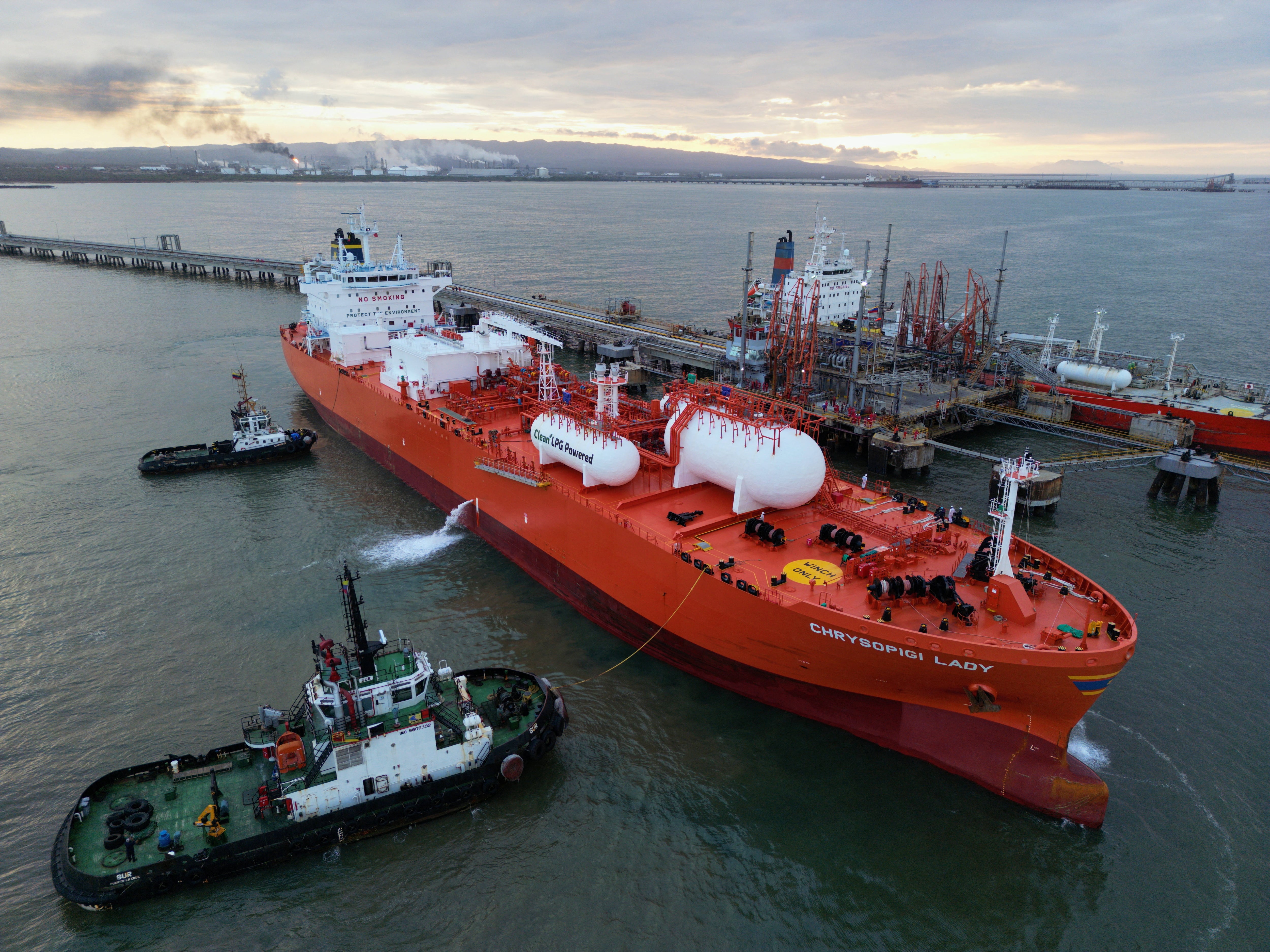
Several major oil and gas companies have recently signed investment agreements with the Venezuelan government to revive the country's oil and gas production. The deals, aimed at reversing years of isolation, have brought a small celebration to the ruling chavismo government, which is in urgent need of resources to address a severe inflation crisis and production shortfall.
The announcements, finalized by British Petroleum, Shell, and Schlumberger, have been in the works for months and are being carried out under U.S. oversight in Venezuela since January 3, when former President Nicolás Maduro was captured by U.S. soldiers in Caracas. The companies, including Shell, British Petroleum, XRG from the United Arab Emirates, and UCC Holgding from Qatar, have agreed on a work schedule with the government of Delcy Rodríguez to exploit offshore gas fields in the Loran Delta, located in the eastern Venezuelan offshore platform.
These fields are a significant gas reserve off the maritime border with Trinidad, which had been dormant due to the sector crisis in Venezuela. The first phase of exploration was awarded to Shell in June of the previous year, while phase two involves a consortium of BP, United Arab Emirates, and Qatar companies. The goal of this operation, according to sources close to the Venezuelan government, is to begin exporting gas to Europe.
Although Venezuela has the largest gas reserves in Latin America, it is a medium producer, ranking sixth in the region with about 31 million cubic meters per year. Part of this production comes from associated gas from oil extraction. The most ambitious expansion projects in gas production have been put on hold during Hugo Chávez's government and his Petroleum Minister, Rafael Ramírez, amid corruption and waste.
Venezuelan gas production currently accounts for only 10% of the regional total. In the oil sector, Production Participation Agreements were announced with U.S. corporations Hunt Oil and Crossover, and a framework agreement with the U.S.-French consortium Schlumberger, which will also conduct integrated well studies. There is a memorandum of understanding, and some sources estimate future investments in these operations at $2 billion.
The arrival of these companies breaks the static landscape of foreign investment in oil and gas in the country during the time of Nicolás Maduro. A context that was dominated almost exclusively by Chevron, Spanish Repsol, and Italian Eni in their quest for additional licenses to maintain operations. "Venezuela not only shows the world its vast oil and gas reserves, but also the contractual mechanisms that allow those reserves to be turned into surface barrels," said Paula Henao, Minister of Hydrocarbons, who closed the Empowering Venezuela forum in Houston at a meeting in front of the American Association of Petroleum Geologists.
The presence of a representative of the Bolivarian Revolution at an event to calibrate Venezuelan investments in Houston was a completely inconceivable episode before January 3, 2026. "What truly matters in international investment matters is happening in gas," emphasized Francisco Monaldi, a specialist in oil and financial analyst.
"Definitely, this is good news. Some agreements were negotiated years ago with Shell. In Trinidad, there is a gas field on the other side of the border - Manatí, which is the same field -; they have developed the productive chains for their petrochemical projects. Shell has been working with Trinidad for some time. The business with Venezuela would be very attractive, because it is covered by the Gas Law, which has lower royalties and encourages private investment, and because on the Venezuelan side, there is no need to make additional investments, there is installed capacity.
All the gas will be monetized through Trinidad." Monaldi sees the oil landscape as more opaque: companies have not fully migrated to the new legal framework, "there are many uncertainties and very vague operational contracts have been signed, leaving enormous discretionary power to the state. PDVSA has negotiated detailed contracts with private companies.
The CPPH (Productive Participation Hydrocarbons Contract) with Hunt Oil and Crossover is the first signed under the new law." Alejandro Grisanti, a senior partner at the consultancy Ecoanalítica and international financial advisor, says the national petroleum sector will have a participation in the future growth of the country, but warns that it is not yet very high.
"What is certain is that international oil and gas investment has reactivated in Venezuela. It is channeling into those wells that can achieve maximum production increase with a small investment. Yields that had been idle." Grisanti believes that in the medium term, much deeper investments will be needed to expand oil production and return it to its former levels, but he thinks that the development of political circumstances will accelerate these processes.
Grisanti estimates a 5-point growth in GDP for 2026 (despite the earthquake), and positive two-digit rates from 2027 onwards for several years. "We are predicting an annual increase of 200,000 barrels due to this pace," he adds. Currently, Venezuela produces slightly more than 1.2 million barrels of oil per day, far from the three million barrels of its better days.
Grisanti, who points to the arrival of capital in the near future, conditions the rate of recovery to the finalization of the gas sector.
Written by urgent.news from El Pais's reporting — not their text. Machine-written — may contain errors; check the original before relying on it.