A first! 3 supermassive black holes discovered in 1 galaxy
For the first time, astronomers have discovered 3 supermassive black holes in a single galaxy in the early universe. Two of them are merging! The post A first! 3 supermassive black holes discovered in 1 galaxy first appeared on EarthSky .
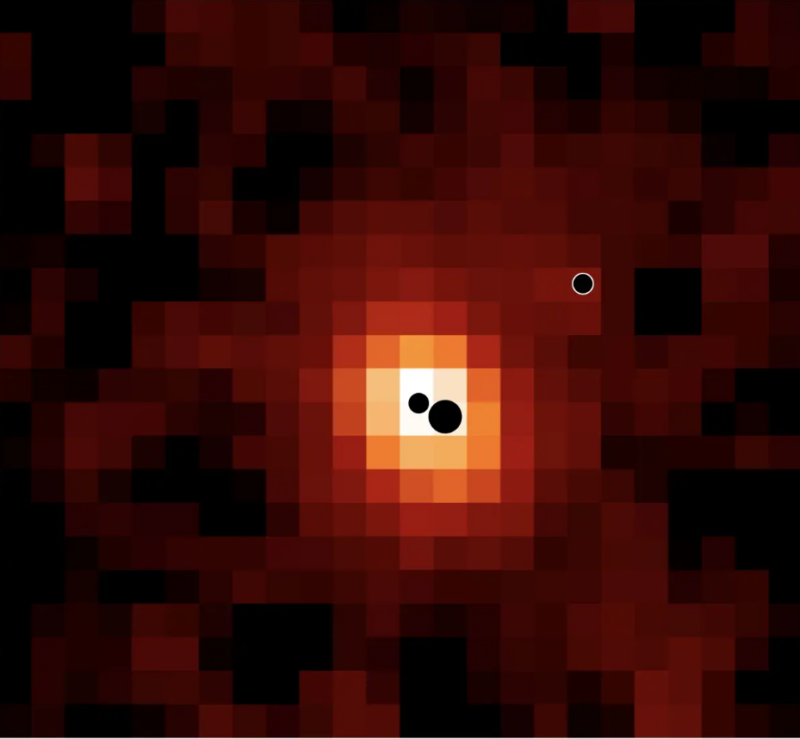
Scientists have made a groundbreaking discovery in the distant galaxy J0148-4214, observing three supermassive black holes for the very first time ever. These colossal black holes – weighing 80 million, 2 million and 6 thousand times the mass of our Sun – were found nestled within J0148-4214, located 12.5 billion light-years away from Earth.
This discovery was made possible through the use of the Webb space telescope's NIRSpec instrument, which provided crucial insights into the spectral signature of the galaxy. The presence of high-velocity hydrogen gas allowed the researchers to confidently identify the three separate black holes within the galaxy. Astonishingly, the smallest of the three black holes was found to be accreting at the fastest rate, defying the predictions of theoretical black hole growth models.
The researchers speculate that these early-universe black holes' rapid growth may be due to efficient processes that brought massive black holes together, paving the way for the supermassive black holes we witness in our universe today. Furthermore, the central two black holes are on a collision course, expected to merge within the next few hundred million years. This finding suggests that black hole mergers could be a rapid growth route for black holes in the early universe.
Written by urgent.news from EarthSky's reporting — not their text. Machine-written — may contain errors; check the original before relying on it.