Mumbai Consumer Commission Pulls Up Max Bupa, Orders ₹5 Lakh Payout Over Repudiated Health Insurance Claim
Mumbai, August 19, 2026: The Suburban Mumbai District Consumer Dispute Redressal Commission (DCDRC) has held Max Bupa health insurance firm guilty of deficiency in providing required services by repudiating the claim. While pulling up the insurance firm, the commission in its orders maintained that insurance policies must be construed to promote fairness and justice rather than to penalise the…
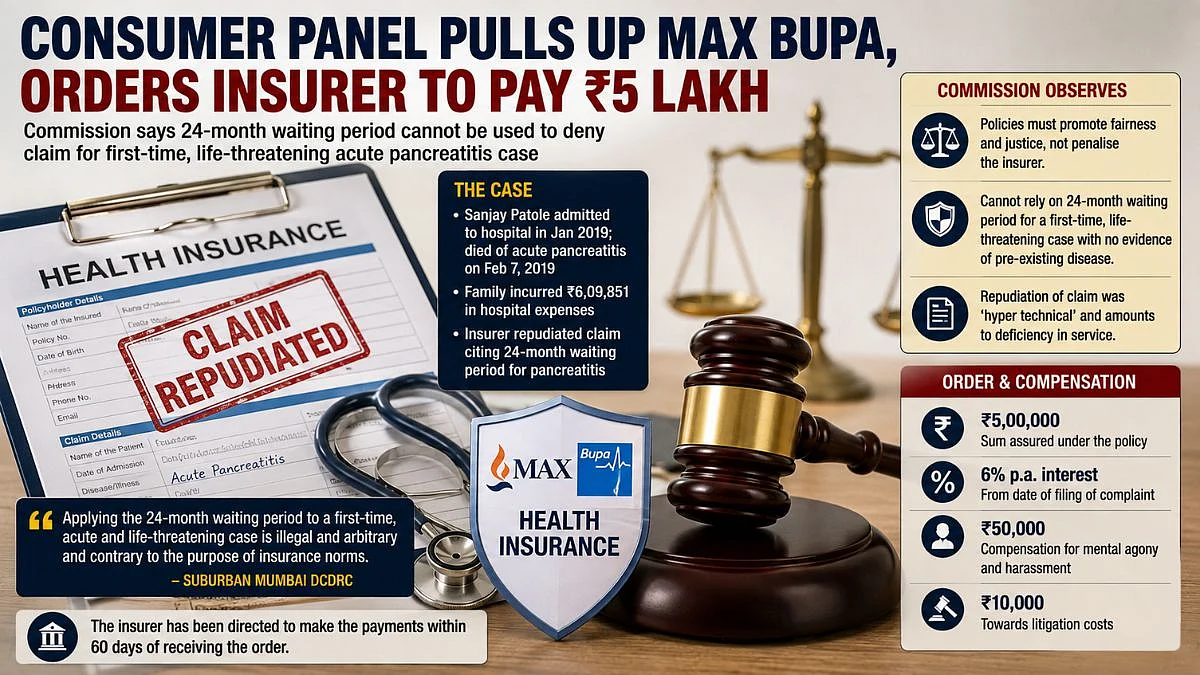
On August 19, 2026, the Suburban Mumbai District Consumer Dispute Redressal Commission (DCDRC) criticized health insurer Max Bupa for their handling of a repudiated health insurance claim. The commission found fault with the insurer for its deficiency in providing required services. The commission emphasized that insurance policies should promote fairness and justice, not penalize insurers.
The insurer was ordered to pay the ₹5 lakh sum assured under the policy, plus 6% annual interest from the date of the complaint. Additionally, the commission awarded ₹50,000 for mental anguish and harassment, and ₹10,000 for litigation costs. The order was issued on July 3, 2026.
The complaint was filed by Sujata Sanjay Patole, whose husband Sanjay Patole passed away on February 7, 2019, due to acute pancreatitis with multiple organ failure. He had initially sought treatment at Criticare Hospital, Andheri, on January 31, 2019, after experiencing severe stomach pain, vomiting, and sweating. His condition worsened, and he was placed on a ventilator before being transferred to Lilavati Hospital for advanced care.
Patole had purchased a Health Companion Variant 2 policy in October 2017 for a sum assured of ₹5 lakh, which was later renewed. The family incurred medical expenses of ₹1,94,257 at Criticare Hospital and ₹4,15,594 at Lilavati Hospital, totaling ₹6,09,851. Despite the policy being cashless, the complainant was initially required to pay the hospital bills, only to be assured they would be reimbursed.
The insurer later repudiated the claims, citing specific waiting period clauses in the policy for pancreatitis and stones in the biliary and urinary system. The insurer argued that these waiting periods were part of the policy terms and aligned with IRDA guidelines. However, the commission rejected the insurer's position. It noted that neither the complainant nor the insurer had evidence of any pre-existing pancreatitis, as a doctor's certificate confirmed that Patole's case was rare with no apparent cause and no symptoms before hospitalization.
The insurer failed to produce any contrary or expert evidence. The commission found the insurer's use of the 24-month waiting period to be "illegal and arbitrary" and not applicable to a first-time, life-threatening case. The commission deemed the insurer's repudiation "hyper-technical" and deficient in service.
Written by urgent.news from Free Press Journal's reporting — not their text. Machine-written — may contain errors; check the original before relying on it.