MIT engineers design a better controller for operating construction diggers
The new, more intuitive system could speed up the training process for excavator operators.
Operating construction diggers can be a challenging task, much like maneuvering a claw machine at an arcade. Much like the joystick controls in an arcade game, an excavator operator uses joysticks to guide the machine’s boom, arm, bucket, and cab. However, the complexity of controlling an excavator is far greater. It can take years for operators to master the necessary skills and mental maps to effectively perform their duties.
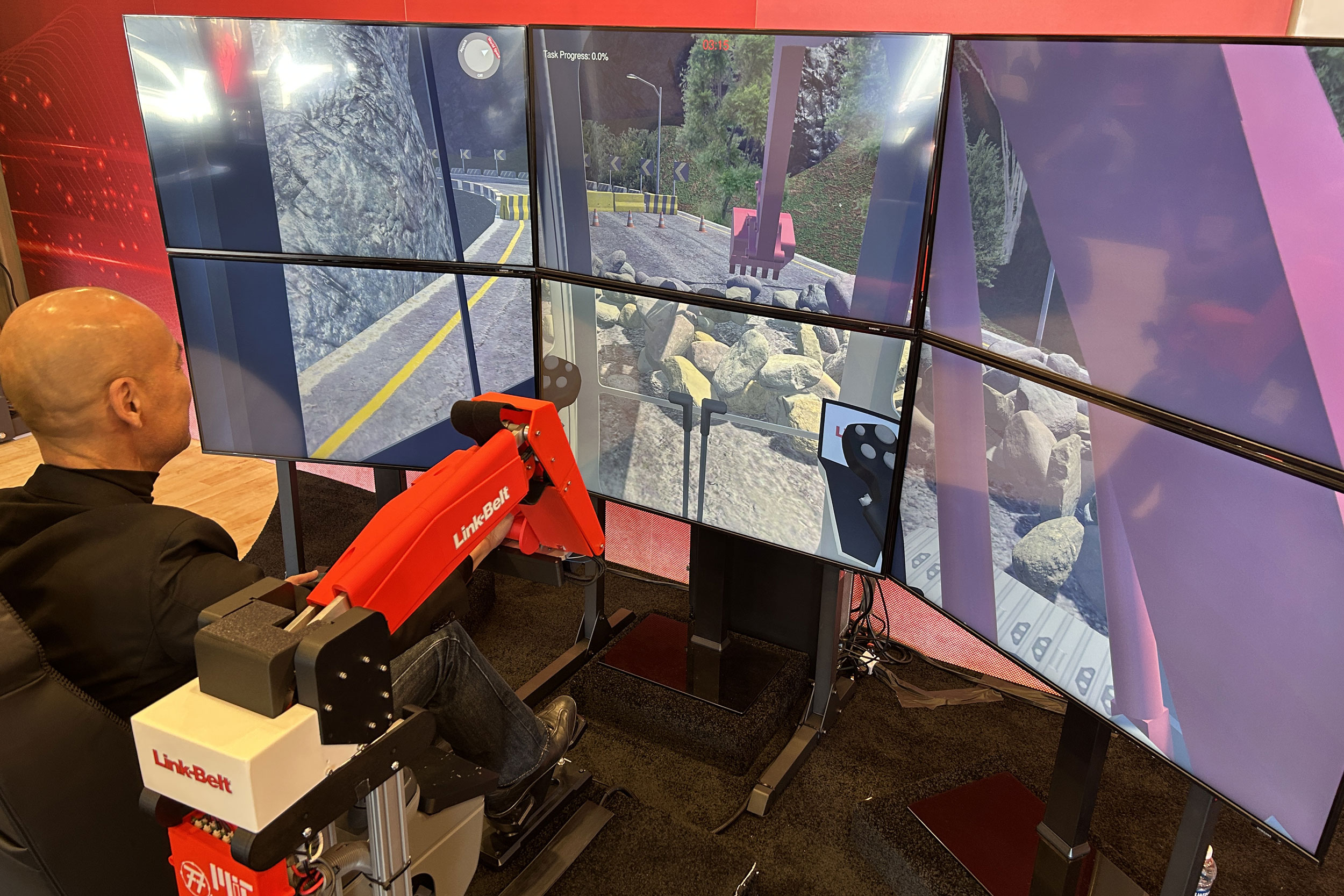
MIT engineers have developed a new training interface that promises to shorten the learning curve for excavator operators. Instead of relying on joysticks, the team has created a more intuitive controller that mimics the mechanics of a miniature excavator arm and bucket. Trainees grasp the device, and their arm and hand movements are translated into the movements of the virtual excavator displayed on a six-screen immersive screen.
Hermano Krebs, a principal research scientist at MIT’s Department of Mechanical Engineering, explains that this new interface allows operators to bypass the need for complex mental maps and instead physically interact with the machine in a more intuitive manner. The interface could be used on-site or remotely, enabling operators to control the excavator from a safe distance in challenging or hazardous environments.
The team’s open-access results, published in the Journal of Computing and Civil Engineering, were developed in collaboration with Sumitomo Heavy Industries, a Japanese industrial machinery manufacturer. Heavy machinery operators often learn by practicing on controlled driving courses, but this method can be time-consuming, with novices requiring months to years to build the necessary expertise.
The MIT researchers reasoned that removing the need for these mental maps could significantly speed up the training process. By designing a mechanical arm that resembles the excavator’s arm and bucket, operators can directly mimic and control the machine’s movements without extensive mental translation. The researchers developed a training platform, called the World-Space Interface (WSI), which combines the mechanical arm with a virtual simulator.
In their study, the team compared the performance of volunteers using the WSI with those using a traditional joystick-based simulator. The virtual simulations encompassed 15 realistic excavation environments and various tasks, including scooping, dumping, digging, grading, clearing debris, and breaking rocks. After a week of training, the researchers found that novices using the World-Space Interface performed just as well as expert operators, demonstrating the potential of this new training interface to revolutionize the way excavator operators are trained.
Written by urgent.news from MIT News Research's reporting — not their text. Machine-written — may contain errors; check the original before relying on it.