Geldanlage: Kann eine 150 Jahre alte Grafik die Börsenkurse vorhersagen?
Aus dem Handelsblatt-Archiv: Eine Kurve aus dem 19. Jahrhundert sagt erstaunlich präzise die Entwicklung der Märkte voraus. Für 2026 empfiehlt sie, Aktien zu verkaufen. Wie verlässlich das wirklich ist.
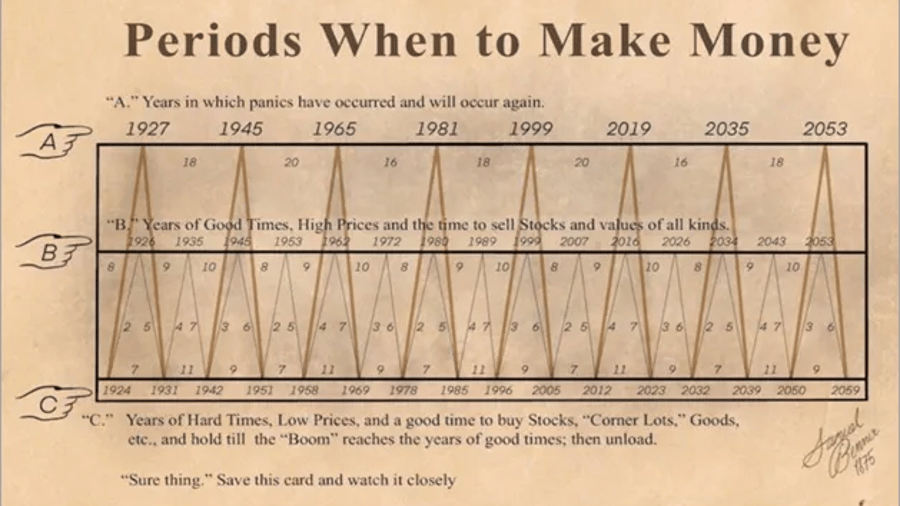
Investors dream of predicting stock market trends for future years to make wise investments and achieve high returns. A 150-year-old graph from the 1870s named "Periods when to make Money" supposedly has this lucrative promise. The graph shows cyclical market developments and provides recommendations on when to buy stocks. Hobby analysts frequently point out that the curve has accurately predicted crises such as the 1929 crash, the Dotcom bubble burst in the early 2000s, and the 2020 COVID-19 crash.
The graph also mentions 2026, advising investors to sell assets. However, the graph's accuracy is attributed to chance probability rather than genuine analysis. Professor Andreas Hackethal from the Frankfurt Institute for Financial Market Research SAFE explains that the graph is based on astrological constellations, not economic reasoning.
He clarifies that "this has nothing to do with the markets." The graph's origin is unclear, with some sources suggesting it was based on pig farmer Samuel Bennet's predictions for pork and maize prices, while others credit George Tritch for extending it to 2059 and adding astrology. Despite its age, the graph continues to attract attention due to its surprisingly accurate predictions, achieving a 90% success rate in some cases.
It remains prevalent in social media, YouTube videos, and blogs. Many investors fascinated by its relevance are unsure of its future applicability. Hackethal attributes the graph's remarkable accuracy to pure probability, stating that if 100 people had been asked for a stock market prediction a century ago, many would have been relatively accurate.
The forgotten wrong predictions are now lost to history. The graph's success is not guaranteed for the future; rather, it had luck on its side. The professor emphasizes that the financial market is too complex to recognize cycles, as price fluctuations are caused by various factors, including technological breakthroughs and investor sentiment.
He warns that trying to time the market, or market timing, does not work, as only a few capital gains days determine most of the return. Missing the top ten days in a year can already lead to negative returns. He emphasizes that diversification and patience are two fundamental rules for successful investing, more valuable than relying on a 150-year-old prophecy.
Written by urgent.news from Handelsblatt's reporting — not their text. Machine-written — may contain errors; check the original before relying on it.
This story
This is one outlet's version. Read the fullest account.
- Geldanlage: „Auch eine Rentnerin kann 100 Prozent Aktien vertragen“ handelsblatt.com