Astronomers discover a black hole star, a new type of object
Astronomers believe the little red dots we see in the early universe are a newly discovered type of object called a black hole star. The post Astronomers discover a black hole star, a new type of object first appeared on EarthSky .
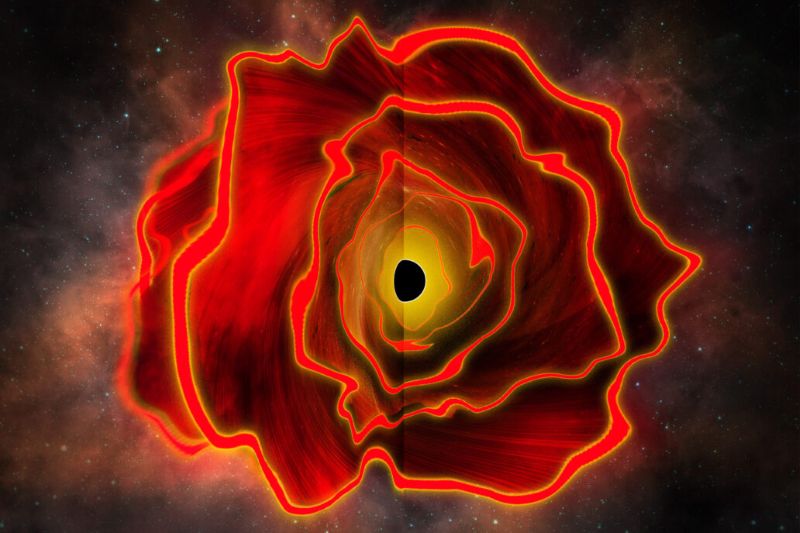
Astronomers have identified a new celestial object, dubbed a "black hole star," which provides an explanation for the previously mysterious "Little Red Dots" observed in distant galaxies. This phenomenon was unveiled by researchers at the Massachusetts Institute of Technology (MIT) and published in the journal Nature on August 12, 2026.
Since its launch in 2022, the James Webb Space Telescope (JWST) has captured images of the early universe, revealing the presence of these enigmatic Little Red Dots. Lead author Rohan Naidu explained that these objects, which appear in images roughly 1 billion years after the Big Bang, are vastly larger than any known stars, with an energy output 100 billion times greater than any existing star.
The dominant feature of a black hole star appears to be a central black hole, 100,000 times larger than the Sun, surrounded by a dense hydrogen cocoon that resembles a star in size, spanning the dimensions of our solar system.
The researchers' findings were based on a survey of the most distant galaxies, known as Mirage or Miracle (MoM), which aimed to detect early galaxies beyond the expectations of previous observations. As they examined the light emitted by these objects using spectroscopy, the team noted an unusual lack of elements beyond hydrogen and helium, along with a profound spectral break that ruled out the presence of ordinary stars.
When considering the reddish hue of these objects, the researchers hypothesized that a dense hydrogen envelope could account for their unique appearance, as dust was not the likely culprit. Simcoe elaborated that hydrogen-enriched atmospheres could produce the observed redness, making it plausible that the Little Red Dots are, in fact, black hole stars.
The simulations conducted by the team supported the hypothesis that an active, accreting black hole at the core of a dense hydrogen cocoon could account for the observed brightness of these red dots. Specifically, the most prominent example, named MoM-BH*-1, consists of a black hole 100,000 times more massive than the Sun, ensconced within a hydrogen-rich cocoon the size of our solar system. The researchers surmise that MoM-BH*-1 is responsible for the intense light observed, effectively outshining its host galaxy.
In conclusion, the discovery of black hole stars may provide a new perspective on the evolution of galaxies in the early universe. The MIT researchers believe that this newly identified celestial object category could account for the vast majority of Little Red Dots observed, although further studies are required to confirm this hypothesis across a broader set of cosmic phenomena.
Written by urgent.news from EarthSky's reporting — not their text. Machine-written — may contain errors; check the original before relying on it.