Marathon runners are training for a hotter world
They are adjusting their pace, making changes to their running schedules and locations, and donning gear that helps them keep cool.
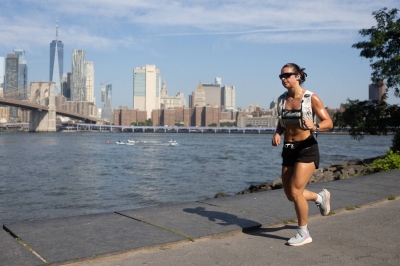
Marathon runners are preparing for a world with rising temperatures. A July Fourth weekend heat wave prompted Jen Dimascio-Donohue, a New York-based project manager, to purchase an Omius cooling headband after an 11-kilometer run in Massachusetts saw temperatures exceeding 27 degrees Celsius by 10 a.m. Dimascio-Donohue now uses the headband during her regular runs, rewetting it every 30 minutes for a cooling effect.
Climate change-induced high temperatures and humidity are impacting training schedules and race day conditions. Experts advise runners to adjust their pace, run during cooler times of the day, and run indoors if necessary. Runna's coaching app discovered that 80% of its users alter or skip their runs due to hot weather, and that number jumps to 92% in the U.S. Sun Belt.
Runna has introduced a heat-adaptation update using local weather data to adjust a subscriber's pace, enabling them to maintain the same training effort as on a cooler day.
Exercise scientists are increasingly emphasizing training the body to cope with heat stress. Chris Douge, training for the Chicago Marathon, has included sauna sessions three times a week in his routine, deeming heat management as crucial as choosing appropriate footwear. According to Professor Christopher Minson from the University of Oregon, the human body can adapt to heat over time. He recommends starting heat exposure at least a month before a race and incorporating it into regular training routines.
As peak heat windows extend later in the day, athletes must adapt their schedules accordingly. Emma Kirk-Odunubi, a London-based sports scientist and running coach, notes that the hottest time has shifted from 12 to 2 p.m. to past 5 or 6 p.m. QuHarrison Terry, preparing for the Great World Race, has moved his training to early evenings due to heat in Dallas.
In Hong Kong, where heat has always been a challenge, Sylvia Lour, a telecommunications strategist, no longer attends early morning group runs due to the intense sun and heat.
Despite thorough preparation, race day weather remains unpredictable. Traditionally, fall marathons in cities like Berlin, Chicago, and New York had cool conditions with low humidity and temperatures around 2 C to 13 C. However, a Climate Central analysis of 221 global marathons reveals that these cooler race days are becoming rarer.
Andrew Pershing, the nonprofit's chief program officer, cites the cancellation of the Twin Cities Marathon in 2023 due to extreme heat and attributes the trend to climate change. In recent years, record-breaking high temperatures have occurred during late September marathons in cities like Minneapolis and St. Paul, raising concerns about the increasing risk of heat affecting performance and safety.
Written by urgent.news from Japan Times's reporting — not their text. Machine-written — may contain errors; check the original before relying on it.