India gifted CERN a Shiva Nataraja statue in 2004 - here's why
In 2004, India presented CERN with a statue of Shiva Nataraja, a powerful symbol of cosmic creation and destruction. This statue serves as a metaphor for the essence of scientific exploration. At CERN, researchers delve into the universe's tiniest components and its earliest moments, viewing Shiva's dance as a representation of the ever-changing behavior of subatomic particles, weaving together…
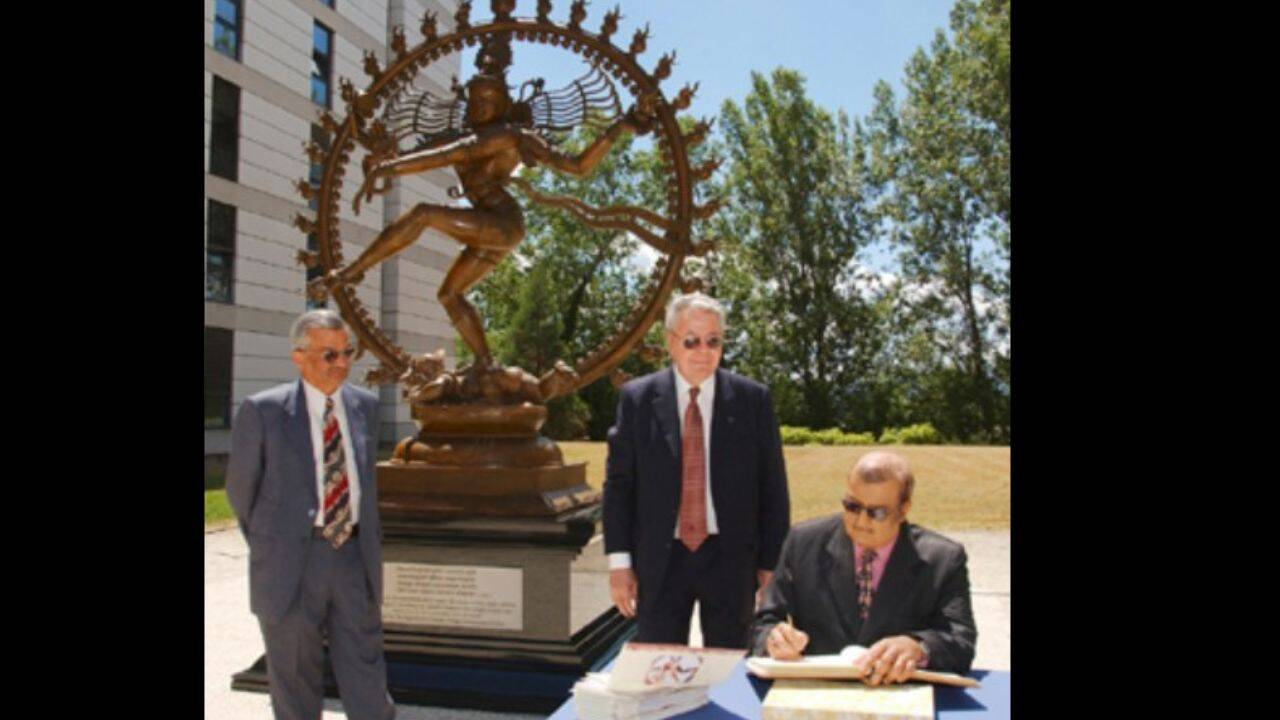
In 2004, the renowned CERN laboratory near Geneva, Switzerland, received a unique gift from India - a 2-metre tall bronze statue of the Hindu deity Shiva in his Nataraja form. This statue, also known as the cosmic dancer, represents the ancient Indian concept of cosmic creation and destruction, and now stands as a striking contrast to the laboratory's scientific focus.
CERN, or Conseil Européen pour la Recherche Nucléaire (European Council for Nuclear Research), is the world's largest particle physics laboratory, whose primary mission is to recreate conditions of the early universe. This is achieved through the operation of the Large Hadron Collider (LHC), a 27-kilometre ring that accelerates particles to near-light speed. The LHC then brings these particles into collision, allowing scientists to study the fundamental particles and forces that constitute our universe.
The Nataraja statue serves as a metaphor for the dynamic universe that particle physicists are investigating. It signifies the never-ending cycle of creation, transformation, and destruction that the laboratory seeks to understand. The statue was gifted by India to celebrate the longstanding scientific partnership between the two nations, with a history dating back to the 1960s.
CERN Director-General Robert Aymar, Indian Atomic Energy Commission chairman Anil Kakodkar, and India's ambassador K. M. Chandrasekhar unveiled the statue on June 18, 2004. The statue's presence at CERN highlights the connection between ancient mythology, religious art, and modern science, offering visitors a unique perspective on both the laboratory's scientific endeavors and the rich cultural heritage of India.
Written by urgent.news from Times of India's reporting — not their text. Machine-written — may contain errors; check the original before relying on it.