Dark matter could magnify the jets of a ravenously feeding supermassive black hole
A jet erupting from a distant supermassive black hole-powered blazar is being gravitationally lensed by an unseen clump of dark matter, and that could tell us about the source of cosmic "ghost" particles.
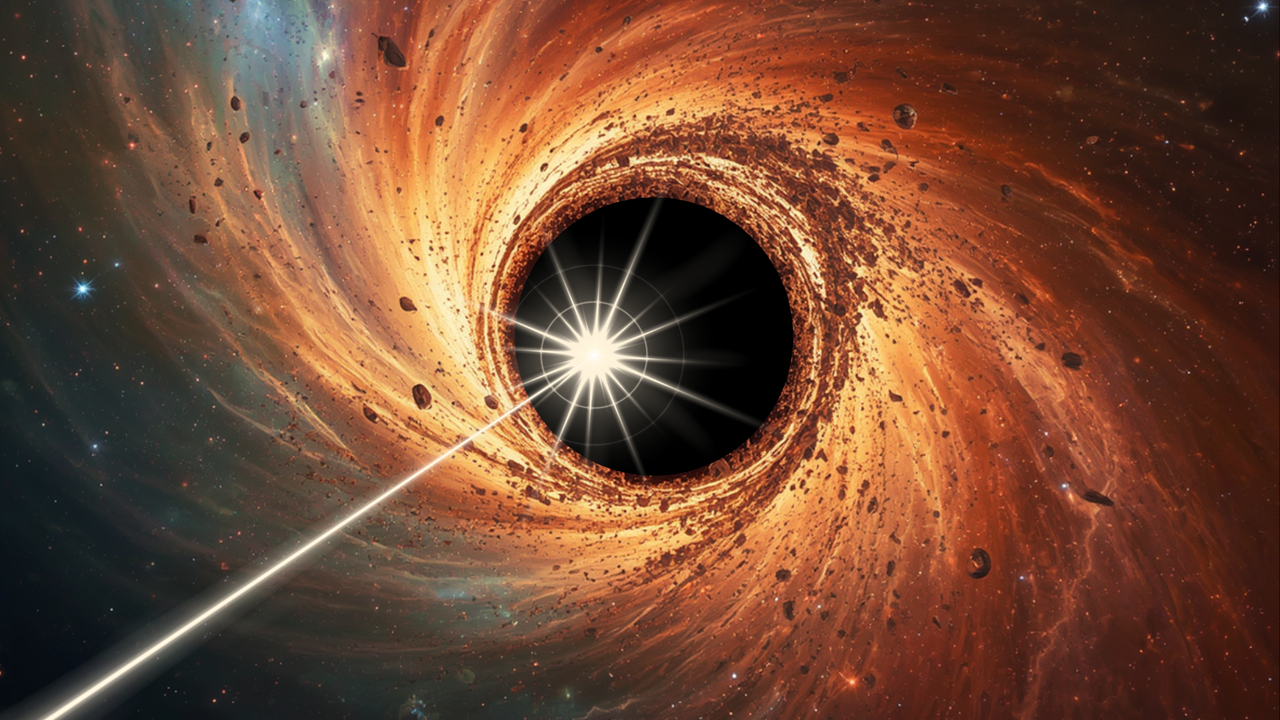
Astronomers have discovered a jet of plasma from a supermassive black hole being gravitationally lensed by an invisible clump of dark matter. This finding could help unravel the enigma of cosmic neutrinos. The supermassive black hole is feeding and emitting jets characteristic of a blazar, a type of quasar. Blazars direct their jets towards Earth, making them prime candidates for neutrino production.
Neutrinos are nearly massless particles that are difficult to detect and trace back to their source. The gravitational lensing effect, predicted by Einstein's general relativity, occurs when light from a background source is bent around a massive object, magnifying or creating multiple images of that source. In this case, the lensing is caused by dark matter, which is undetectable through conventional means but still exerts a gravitational influence.
The shifted path of the PKS 2233-148 blazar's polar jet, as observed using the Very Long Baseline Array, Fermi space telescope, and the X-ray instrument on the Swift spacecraft, indicates the presence of this dark matter lens. The alignment of this cosmic course correction is temporary and provides a unique opportunity to study the connection between blazars and neutrinos.
Written by urgent.news from Space.com's reporting — not their text. Machine-written — may contain errors; check the original before relying on it.