A record-breaking star could reveal how the Milky Way’s giant black hole spins
The star passes very close to the Milky Way’s supermassive black hole and could reveal the black hole’s spin by tracking how it warps the star’s orbit.
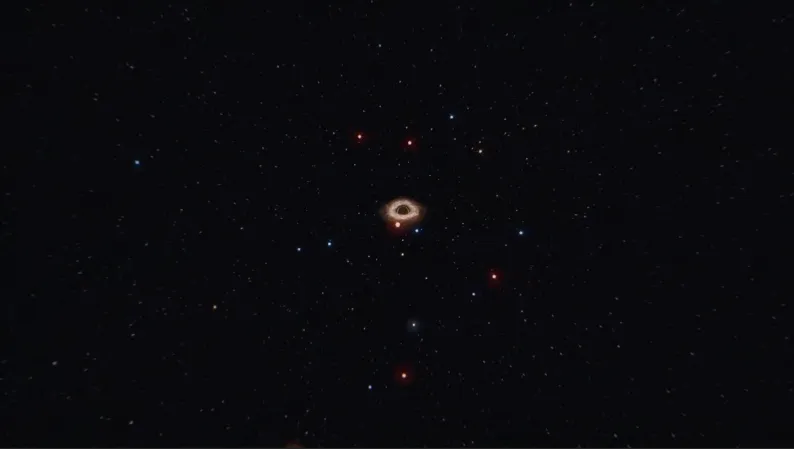
According to a new discovery by the European Southern Observatory’s Very Large Telescope, a star has been identified as the fastest known in our galaxy. This stellar object is hurtling around the supermassive black hole at the center of the Milky Way at a mind-boggling speed of approximately 15,534 miles per second, which is 100,000 times faster than a commercial airplane.
Astronomer Stefan Gillessen of the Max Planck Institute for Extraterrestrial Physics remarked, “That star is really, extremely fast.” This particular star orbits the black hole at an unprecedented proximity, completing a revolution in just 8.7 years. By utilizing the black hole's gravitational pull, the star achieves its extraordinary velocity without being pulled in.
Gillessen and his team detected the star in data from the Very Large Telescope located in Chile's Atacama Desert. Their findings were published in the journal Nature. There are several hundred stars that closely orbit this colossal black hole, influenced by its gravity, and scientists have mapped the orbits of around 50 of them.
The newly discovered star is 10 times closer to the black hole than the previous record holder, implying that it also experiences the effects of the black hole's rotation. Supermassive black holes are present at the center of almost every large galaxy, and it is extremely difficult to understand what's happening inside them as nothing, not even light, can escape them.
Studying stars like this one could assist scientists in measuring the properties of these mysterious black holes, including their spin speed. Advanced telescopes are assisting in pinpointing fainter stars that were previously undetectable, potentially leading to the discovery of even faster stars. Astronomer Tuan Do of the University of California, Los Angeles, who was not involved in the study, stated that this is only the beginning, as as we look for fainter stars, there should be many more stars like this waiting to be discovered.
Written by urgent.news from CityNews's reporting — not their text. Machine-written — may contain errors; check the original before relying on it.
This story
This is one outlet's version. Read the fullest account.
- Telescope spies the fastest star in the Milky Way zipping around a black hole apnews.com
- Fastest known Milky Way star offers new test of supermassive black hole's spin phys.org
- Telescope spies the fastest star in the Milky Way zipping around a black hole toronto.citynews.ca
- Telescope spies the fastest star in the Milky Way zipping around a black hole winnipegfreepress.com