Webb's 'little red dots' puzzled astronomers; this galaxy may hold the answer
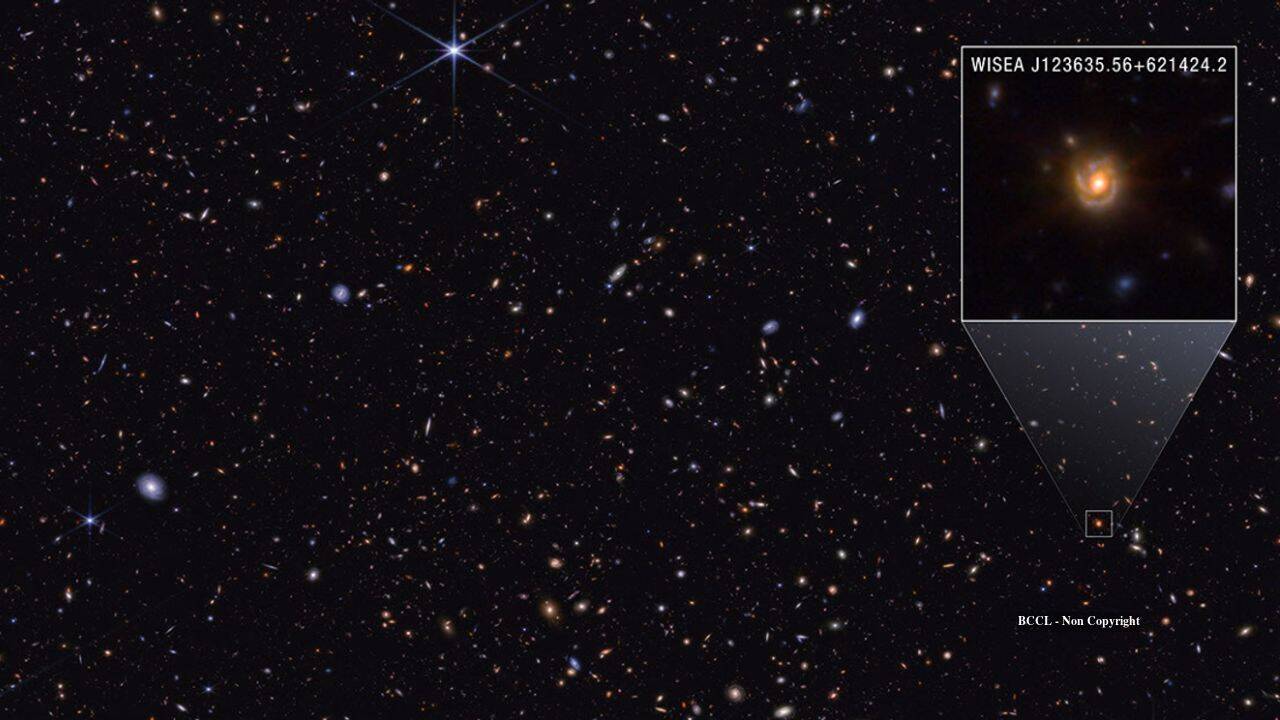
In July 2023, astronomers published a study titled "Beyond the Dot: An LRD-like Nucleus at the Heart of an IR-bright Galaxy and its Implications for High-redshift LRDs," suggesting that mysterious "little red dots" (LRDs) in the early universe may be linked to spiral galaxies. Since their discovery in 2022 by NASA's James Webb Space Telescope, LRDs have puzzled scientists due to their elusive nature.
While some speculate that LRDs are supermassive black holes called active galactic nuclei, their behavior differs from those observed nearby. A new study focusing on a galaxy nicknamed "Saguaro" may hold the answer. Saguaro, located 3.3 billion years after the Big Bang, exhibits characteristics similar to LRDs. The researchers found that the galaxy's central compact red source shares similarities with LRDs, and its X-ray emission further supports this connection.
The study also indicates that distant LRDs may appear isolated due to observational bias, as surrounding galaxies become too faint for current telescopes to detect. This new finding sheds light on the evolutionary path of LRDs, suggesting that they may be a hidden phase of black hole growth within spiral galaxies.
Written by urgent.news from Times of India's reporting — not their text. Machine-written — may contain errors; check the original before relying on it.