Scientists may have finally proved that “empty” space isn’t really empty
A magnetar’s colossal magnetic field may have revealed a quantum effect predicted by Werner Heisenberg nearly 90 years ago, in which seemingly empty space alters the behavior of light. If confirmed, the discovery could offer the first direct evidence of vacuum birefringence and open a new window into the strange physics of the quantum vacuum.
Scientists may have discovered evidence that "empty" space is not truly empty, according to recent findings published in Nature. This research, led by Dr. Marcus Lower from Swinburne University of Technology, suggests the presence of vacuum birefringence within a magnetar, a rare type of neutron star with the strongest magnetic fields in the universe.
Quantum mechanics, pioneered by Werner Heisenberg nearly 90 years ago, predicts that even a perfect vacuum contains virtual particles that briefly appear and disappear. The strength of a magnetic field can influence these virtual particles, causing them to affect how light travels and produce vacuum birefringence. Magnetars provide a unique opportunity to observe this quantum phenomenon, as their magnetic fields are strong enough to make the effect potentially observable.
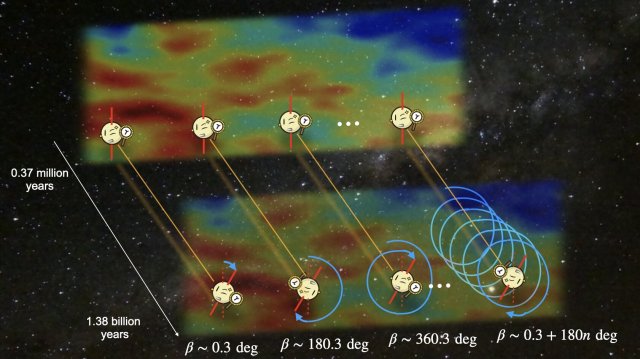
The international research team studied magnetar 1E 1547.0-5408 (or 1E1547) using NASA's Imaging X-ray Polarimetry Explorer (IXPE), NASA's NICER X-ray telescope aboard the International Space Station, and Murriyang, CSIRO's Parkes radio telescope. The researchers observed changes in the direction of radio waves emitted by the magnetar, which helped them determine that the magnetic and rotational axes of 1E 1547 are almost aligned.
The team found two key clues pointing toward the quantum effect. X-rays generated by the magnetar, detected by IXPE, showed extremely high levels of polarization. Moreover, the direction of this polarization remained tied to the magnetar's magnetic field in the same way seen in the radio observations. Due to the magnetic field's strength, the virtual particles become aligned with the direction the field is pointing.
If confirmed, this discovery could allow physicists to test how established theories of quantum physics behave under extreme conditions found in the universe. Further observations and advanced computer simulations are needed to establish whether the signal truly comes from vacuum birefringence. The findings could provide new insights into the quantum nature of empty space.
Written by urgent.news from ScienceDaily's reporting — not their text. Machine-written — may contain errors; check the original before relying on it.