JWST Peeks at Callisto’s Ancient Scars
Of Jupiter’s four Galilean moons, Callisto is the one that gets the least attention. Io is constantly being resurfaced by volcanoes. Europa has a giant liquid water ocean. And Ganymede has its own magnetic field that interacts with its parent planet in weird ways. Callisto, by comparison, seems sedate, with its ancient, crater-saturated surface seemingly frozen in time. But new data from the…
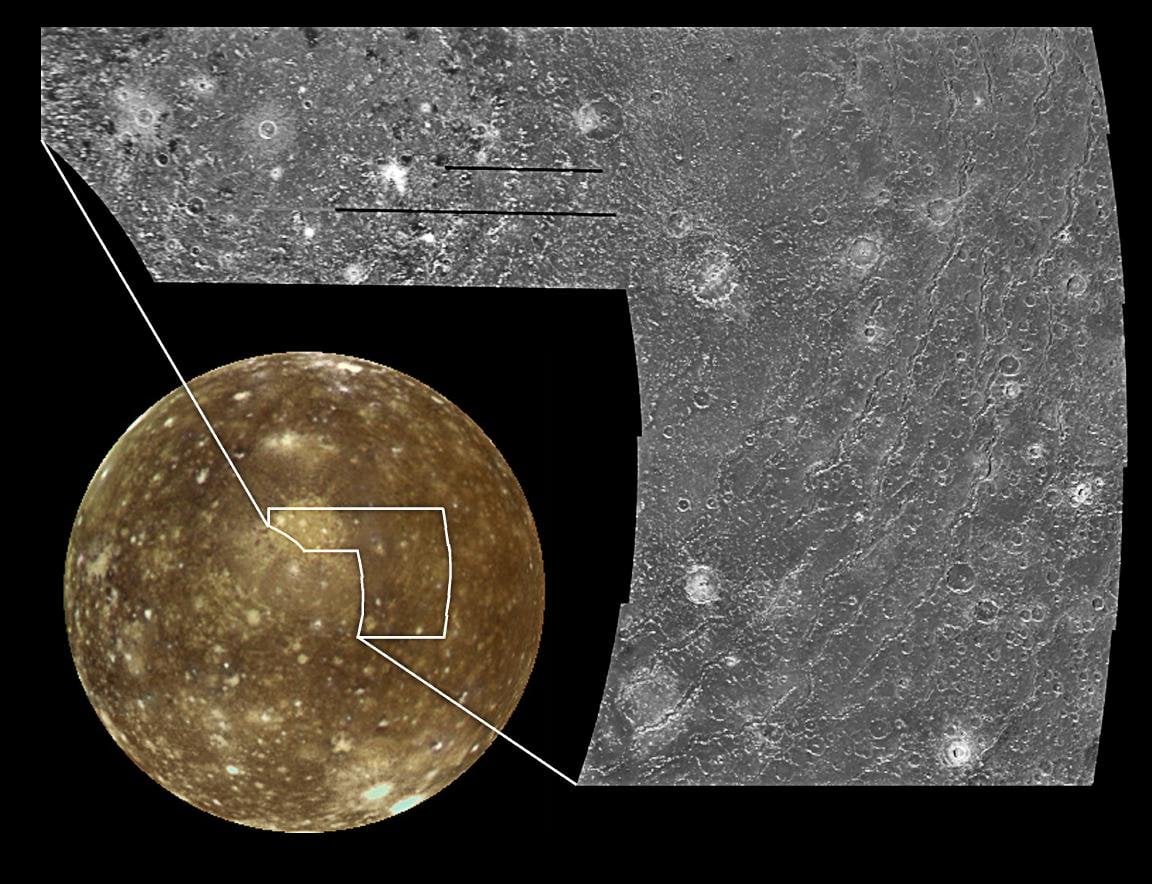
The James Webb Space Telescope (JWST) has revealed that Jupiter's moon Callisto, known for its ancient, crater-saturated surface, is more active than previously thought. Researchers from an international team, led by Maria Camarca of Caltech, used JWST's Near-Infrared Spectrograph (NIRSpec) instrument to study Callisto’s three major perspectives: its trailing hemisphere, the Asgard impact basin, and the Valhalla multi-ring impact structure.
The data showed water ice on Callisto's leading hemisphere, with bright impact basins like Valhalla and Asgard, and younger craters like Lofn and Heimdall, displaying sharp increases in water ice. On the trailing hemisphere, water ice forms a "bullseye" pattern, likely due to plasma blasting from Jupiter's magnetosphere. The researchers also detected a faint atmosphere primarily composed of CO2, with the highest concentrations around the Valhalla basin.
This pattern, similar to other icy moons, suggests that carbon-rich grains are converted into CO2 through particle radiation. Additionally, JWST identified a clear absorption feature at 4.57 µm, possibly caused by carbon-nitrogen compounds. While JWST's observations have provided new insights into Callisto's surface, further understanding of these processes will require data from the upcoming Jupiter Icy Moons Explorer (JUICE) mission.
Written by urgent.news from Universe Today's reporting — not their text. Machine-written — may contain errors; check the original before relying on it.