Give me 5 minutes and I’ll give you Saturn
We're now in the best months for viewing Saturn in 2026. It'll be at it's best around October 4 when it's closest to Earth and visible all night. The post Give me 5 minutes and I’ll give you Saturn first appeared on EarthSky .
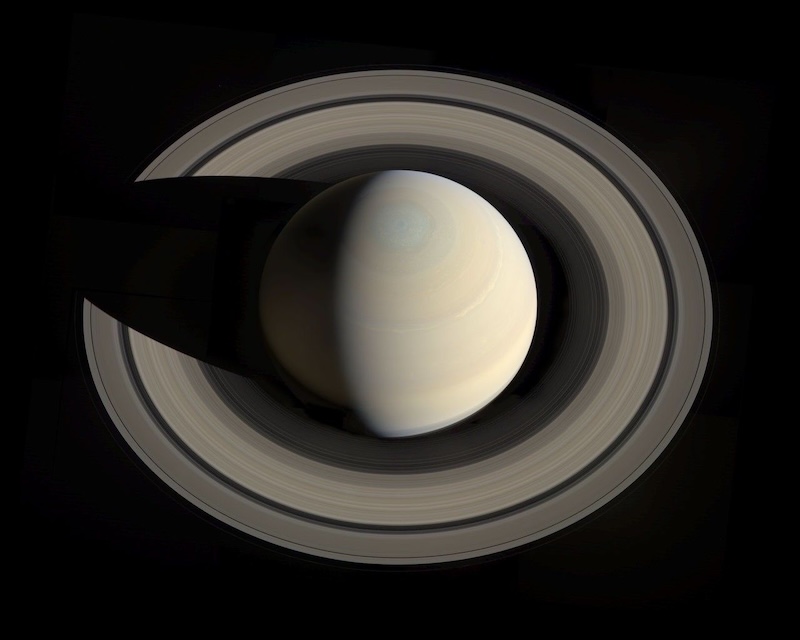
The Cassini spacecraft orbited Saturn from 2004 to 2017, capturing a breathtaking image by swooping repeatedly between the planet's outer atmosphere and its inner rings. This stunning image was created by software engineer Gordan Ugarkovic for NASA. To catch a glimpse of Saturn, head to the sky in mid-August 2026, where it will rise during the middle of the night, appearing as a bright, golden "star." By dawn, Saturn will be at its highest point in the sky.
Saturn is the sixth planet from the sun and the farthest visible to the naked eye, boasting a faint and slow-moving appearance. While a telescope is required to admire the planet's rings, Saturn's golden hue can be appreciated with the unaided eye. Being the farthest of the bright planets, Saturn takes approximately 30 years to orbit the sun, moving more slowly than the others in front of the fixed stars.
In ancient Assyrian times, Saturn was called Lubad-sag-uš, often translated as the oldest of the old sheep, a name that reflects its slow movement across the sky. It takes nearly 30 years for Saturn to complete one journey across our sky, passing through all constellations in the zodiac. Though it appears to amble across the sky like an old sheep, Saturn is more challenging to recognize than the other bright planets.
However, a handy tool to help identify it is the moon. Look for Saturn near the moon on August 29 and 30, 2026, and again near the full moon on September 27 and every month thereafter.
The best time to view Saturn in 2026 is during its yearly opposition on October 4, when Earth will be positioned between the sun and Saturn. This event will make Saturn appear opposite the sun in our sky, rising at a convenient hour for observation. During opposition, Saturn will be closest to Earth, appearing at its brightest. Saturn is the faintest of the bright planets but can be easily spotted due to its proximity and golden color.
When Saturn retrogrades from July 27 to December 11 in 2026, it will move westward in front of the stars, providing a unique celestial show as it traverses the zodiac. By remembering to look along the sun's path, or the ecliptic, along with identifying bright lights and the steady, golden hue of Saturn, you'll be well on your way to recognizing this beautiful planet in the night sky.
Written by urgent.news from EarthSky's reporting — not their text. Machine-written — may contain errors; check the original before relying on it.