Giant underwater plume blasts into swirling cloud 'street' in the East China Sea — Earth from space
A recent satellite photo captured a series of clouds sculpted by von Kármán vortices from a volcano on South Korea's Jeju Island. A giant multicolor plume, ejected by China's Yangtze River, is also visible in the image.
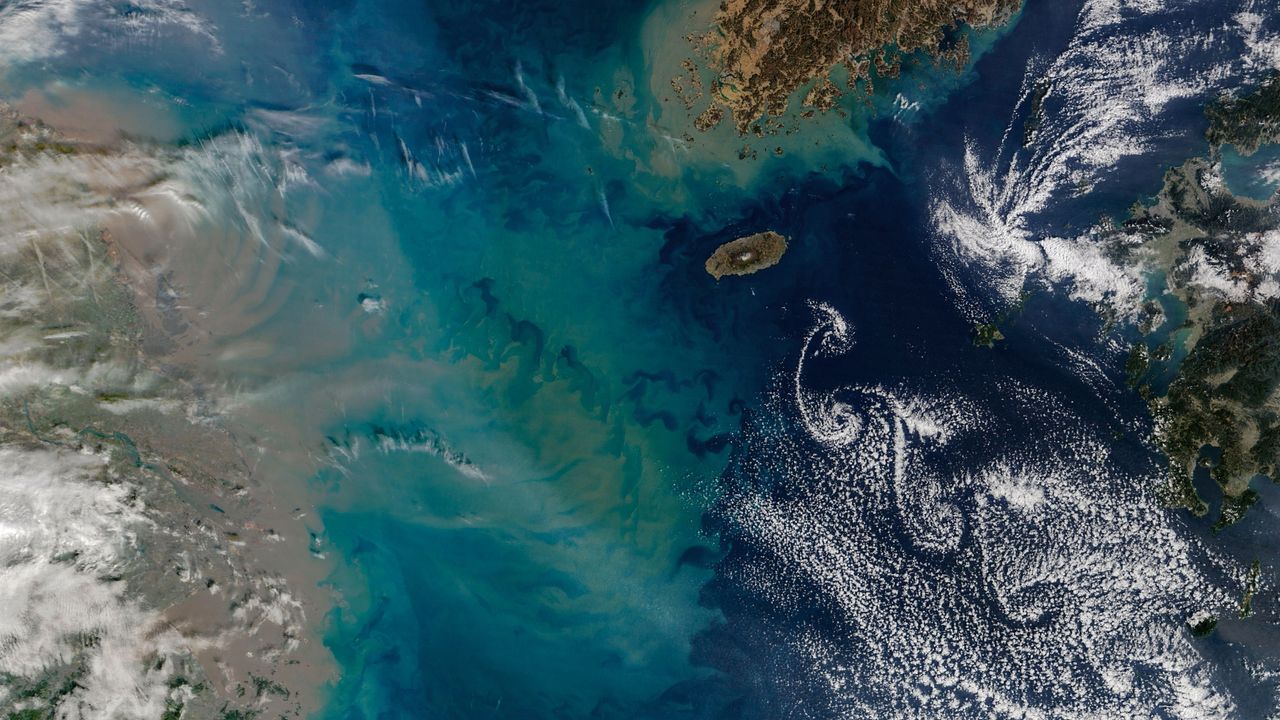
In the East China Sea, a striking image captures the convergence of swirling clouds and a massive sediment plume, captured by NASA's Terra satellite on February 19, 2026. The swirling clouds, known as Kármán vortex streets, were formed as winds circled the 6,400-foot-tall Hallasan shield volcano on Jeju Island, South Korea. Located between China's Jiangsu province and Japan's Kyushu island, the volcano sits approximately 60 miles south of the Korean Peninsula.
The swirling patterns, stretching up to 230 miles long, are the result of counterrotating vortices that form on the downwind side of the volcano. Beneath the waves, a thick brownish curtain of sediment stretches along China's eastern coastline, primarily discharged by the Yangtze River, the third-longest river in the world. A more distinct yellow and green sediment plume extends up to 270 miles from the coast, seemingly touching the vortices.
This unusual combination of atmospheric and oceanographic phenomena occurs due to increased turbulence in the Yangtze caused by heavy rainfall, stronger seasonal currents, and vertical ocean mixing during winter. While von Kármán vortices are common near large islands with high peaks, such as Mexico's Guadalupe Island or Spain's Canary Islands, it is rare to see ocean and atmospheric events occurring simultaneously.
Jeju Island, created by a submarine volcanic eruption around 2 million years ago, has been inhabited by the Jeju people for at least 8,000 years. The island's residents possess unique genetic mutations that enable them to free dive in deep and cold waters without specialized equipment. Hallasan, also known as Mount Halla, is South Korea's tallest mountain and an active volcano, with the last eruption recorded in AD 1007.
Written by urgent.news from Live Science's reporting — not their text. Machine-written — may contain errors; check the original before relying on it.