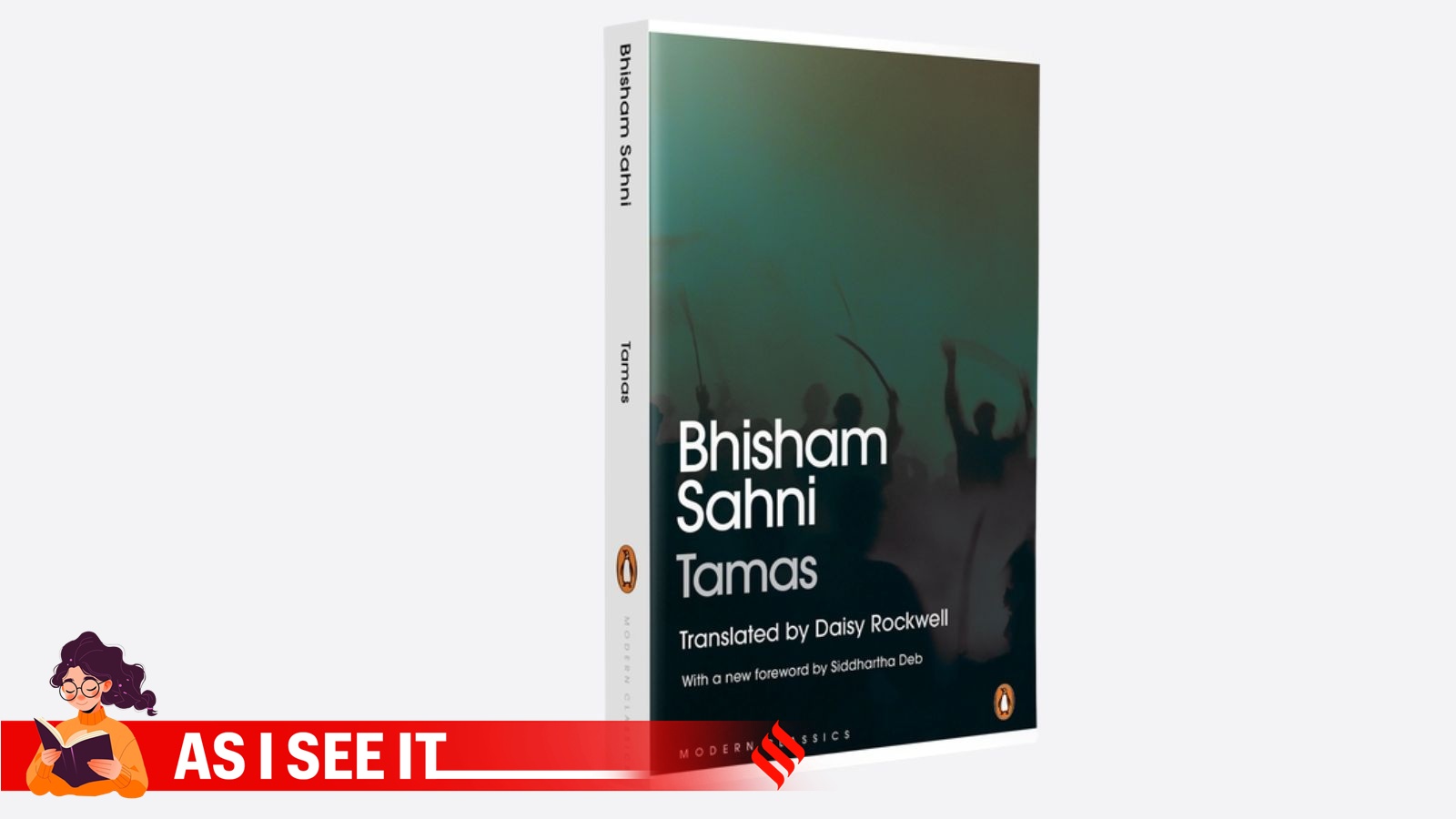
Bhisham Sahni’s Tamas and the anatomy of hate
Growing up, <source>the only understanding of Partition came as a date, a map and a photograph</source>. In 1947, a line was drawn through Punjab and Bengal. Trains arrived empty, leaving behind homes that were dearly cherished. To me, it was a historical event that had transpired when my grandparents were mere children, something safely tucked away in the past.
It wasn't until 2022, when I read Bhisham Sahni's Tamas, that my perception of Partition began to change. Sahni's novel is not focused on the moment a riot erupts; it delves into the intricate process that leads to such violence. It explores how hatred is cultivated in ordinary minds, how it moves from decision-makers to those taking to the streets.
This aspect of the book makes it particularly unsettling to read in today's context. The initial darkness in Tamas is disturbingly small. Nathu, a poor laborer, is paid five rupees by Murad Ali to kill a pig. He doesn't know the reason behind the request; he simply needs the money. By morning, the carcass is outside a mosque, transforming an insignificant act into sacrilege.
This single act escalates into outrage, which then transforms into violence. Nathu is perhaps the most crucial character in the early chapters because he is unaware of the larger game he becomes a pawn in. His poverty limits his ability to comprehend the situation. This dynamic feels all too familiar in the age of WhatsApp forwards, short videos, and outrage spread rapidly.
The person who forwards a message may not know its origin, and the recipient may not know who it will harm. By the time the truth emerges, the rumor has already spread. Another character, Richard, the British Deputy Commissioner, loves Indian history more than most Indians in the book. Despite this passion, he remains passive during the chaos.
He follows orders dutifully, telling local leaders he has no authority to stop the violence, only to restore order once it has served its purpose. The movement from the top to the bottom of society is striking. Politics occurs above, but ordinary individuals pay the price below, often unaware. Ranvir, a 15-year-old, is another prime example of the novel's themes.
He's taught that cruelty can be a form of courage, and killing can be an initiation. The boy, who may have otherwise worried about school, friends, and ordinary teenage concerns, is shown how to view another human as an enemy. We often discuss radicalization as if it creates monsters suddenly. Sahni suggests a more gradual process.
An impressionable mind is given a vocabulary first, followed by a grievance, and then a target. The Muslim peddler, who is kind and innocent, is initially seen as a threat. However, by this point, the boys have been taught to view him not as an individual but as a category. This illustrates how hatred works—first, it teaches you to stop seeing someone as an individual.
'Tamas' helps us understand that hatred doesn't always start with hatred. It can begin with grief, fear, or the feeling that something that belonged to you has been taken away. Someone then comes along and tells you whom to blame. Through 'Tamas,' Sahni reminds us that hatred doesn't always begin with hatred. Sometimes, it starts with grief, fear, or the belief that something of yours has been taken away.
And then, someone comes along and tells you whom to blame. The novel also highlights that communities aren't neatly divided into good and bad people. Individuals can exhibit both compassion and cruelty, sometimes within the same family. This complexity is perhaps what hatred cannot tolerate—neat categories. The novel's ending, where a Peace Committee is formed and Murad Ali, who started the violence, appears at a peace procession, shouting slogans of Hindu-Muslim unity, is perhaps the most contemporary aspect of 'Tamas.'
The darkness of the novel doesn't disappear; it merely changes its appearance. The fact that someone who helped create such upheaval gets away without consequences is particularly frightening. The lesson from 'Tamas' is not that people become violent; we already know that. Instead, it is that people can be made to believe that violence is necessary, justified, even noble, and those who help manufacture this belief can later present themselves as its solution.
The technology, language, and speed may have changed, but the journey of hatred remains the same. It starts at the top, travels down, and by the time it reaches the bottom, nobody remembers who lit the match.
Written by urgent.news from The Indian Express's reporting — not their text. Machine-written — may contain errors; check the original before relying on it.