When Did Animals Start Giving Birth to Live Young? This 236-Million-Year-Old Fossil Might Rewrite Mammals' Evolutionary History
A bone feature found in a mammal ancestor hints that the creature was relatively large as a newborn, more in line with the size of a creature birthed live than hatched from an egg. Still, it provides only indirect evidence
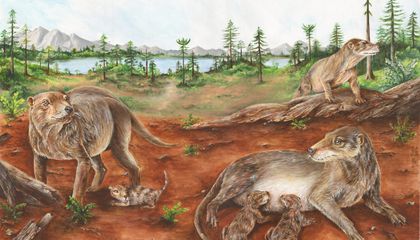
The discovery of a 236-million-year-old fossil may rewrite the evolutionary history of mammals, indicating that live birth occurred much earlier than previously thought. Scientists have found a neonatal growth mark on an adult Chiniquodon theotonicus fossil, suggesting that the creature was born large, similar to a live-birthed animal rather than an egg hatching.
This evidence points to the possibility that mammals transitioned to live birth around 95 million years earlier than previously believed. The Chiniquodon theotonicus was a dog-sized mammal-like reptile that lived between 100 and 260 million years ago and was an ancestor to the first true mammals. Prior to this discovery, it was thought that all non-mammalian cynodonts, like the Chiniquodon theotonicus, laid eggs.
However, the neonatal growth line in the fossil suggests that these animals may have given birth to live young. The researchers compared the body mass ratio of the Chiniquodon theotonicus to that of living mammals, reptiles, and birds, finding that live birth in mammals resulted in significantly larger newborns. This conclusion, while not definitive, supports the idea that live birth in mammals predates previously thought, and raises new questions about the evolutionary origins of live birth in mammals.
Written by urgent.news from Smithsonian's reporting — not their text. Machine-written — may contain errors; check the original before relying on it.