Tidal flat in Nagoya hit by plastic waste pollution
The amount of plastic waste at the tidal flat — a protected wetland hosting diverse wildlife — has researchers concerned about its effect on the ecosystem.
In recent years, a tidal flat in Nagoya has experienced significant plastic waste pollution due to runoff from rivers. The Nagoya City Institute for Environmental Sciences began investigating the issue in 2021, focusing on how microplastics could harm wildlife and ecosystems. As a crucial stopover for migratory birds like sandpipers and plovers, the Fujimae tidal flat, located in the Ise Bay, is vital for preserving diverse wildlife.
In 1981, Nagoya planned to turn the tidal flat into a landfill, but abandoned the idea in 1999 due to strong local opposition. A state of emergency for garbage disposal was declared in 2002, encouraging residents and businesses to sort and reduce waste.
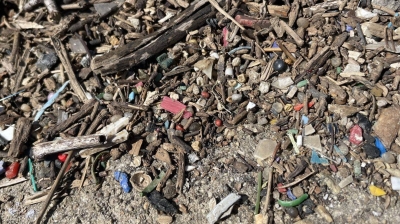
In mid-May, approximately 60 volunteers participating in a beach cleanup found the tidal flat strewn with variously colored and sized plastic fragments. While conspicuous household waste is less prevalent, microplastics have become a concern in recent years. Kazuhiro Banno, a 75-year-old cleanup campaign leader with over two decades of experience, noted that while visible household waste has diminished, small plastic particles have become an issue in recent years.
The Nagoya City Institute for Environmental Sciences collects and sorts debris washed up on the tidal flat annually, finding that 10% to 30% of the total mass is plastic. In 2025, the institute collected 2,864 pieces of plastic debris, with about 98% being microplastics. Trash from rivers and oceans tends to accumulate on tidal flats due to the rise and fall of tides. The Fujimae tidal flat sits at the confluence of the Shonai River, Shin River, and Nikko River, making it a natural gathering point for waste.
Researchers plan to study the three rivers to identify the plastic waste's sources and assess its impact on wildlife and the environment. Kazuhiro Banno emphasized that microplastics represent a microcosm of society's reliance on cheap, lightweight, and hygienic plastics. Satoshi Chiba, a visiting professor at Yokkaichi University specializing in coastal marine environmental science, warned that ingested plastics could hinder nutrient absorption in wildlife and cause toxic effects from pollutants adsorbed on the fragments.
Chiba found that as microplastic particle sizes decrease, they become more easily absorbed into organisms, potentially affecting the entire ecosystem. He stressed the importance of society taking measures to prevent large plastic items from entering the sea.
Written by urgent.news from Japan Times's reporting — not their text. Machine-written — may contain errors; check the original before relying on it.