Q&A: Rethinking how innovation happens
In his latest book, Professor Eugene Fitzgerald examines the forces that turn breakthroughs into value — and why innovation resists simple formulas.
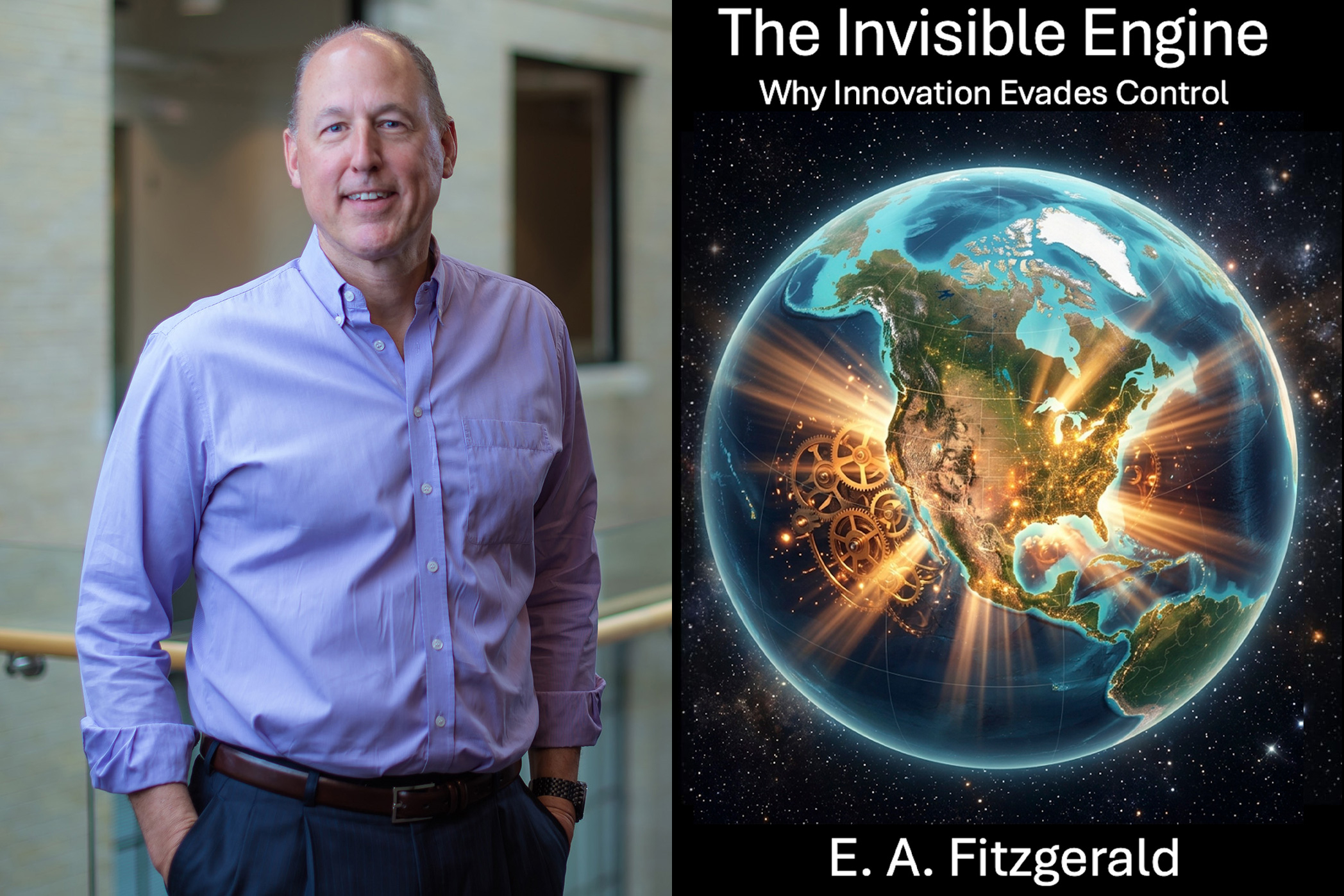
Innovation has become a mythologized concept in modern times, writes Eugene Fitzgerald in his latest book, "The Invisible Engine: Why Innovation Evades Control." Fitzgerald, the Merton C. Flemings SMA Professor in MIT's Department of Materials Science and Engineering, explores innovation as the integration of market applications, technology, and implementation through his decade-long work leading international research programs.
The book delves into how innovation actually happens and how society should invest in it, particularly in a world where artificial intelligence is reshaping knowledge and research. Fitzgerald discusses his experiences with innovation, including his co-invention of strained silicon at AT&T Bell Laboratories in the 1990s, which contributed to extending Moore's Law.
Fitzgerald introduces the term "invisible engine," which refers to the decentralized collective intelligence of individuals and companies that create surprise in the marketplace, leading to great profit. This surprise is what economist Frank Knight described in the early 1900s when examining entrepreneurs and their role in the Industrial Revolution.
Fitzgerald describes three different types of research investment: altruistic science, strategic research, and fundamental innovation. Altruistic science aims to produce educated individuals but does not guarantee economic impact. Strategic research is organized around a specific goal, usually tied to a customer, and has broad uncertainty due to multiple technological domains. Fundamental innovation represents the entirety of the research-to-economic-growth process.
Throughout his career, Fitzgerald's experience transitioning from Bell Labs to MIT to a startup and then to industry adoption served as a practical example of the innovation process. He emphasizes the importance of understanding this process and incorporating knowledge of it into large collaborative research programs to adapt to future uncertainty.
Written by urgent.news from MIT News AI's reporting — not their text. Machine-written — may contain errors; check the original before relying on it.