Niedrige Pegelstände: Höhere Preise und Engpässe - Niedrigwasser trifft Bauherren
Wenn Schiffe weniger laden können, steigen die Transportkosten - auch am Bau. Private Bauherren könnten schon bald steigende Preise und Verzögerungen spüren. Der Druck auf die Branche wächst.
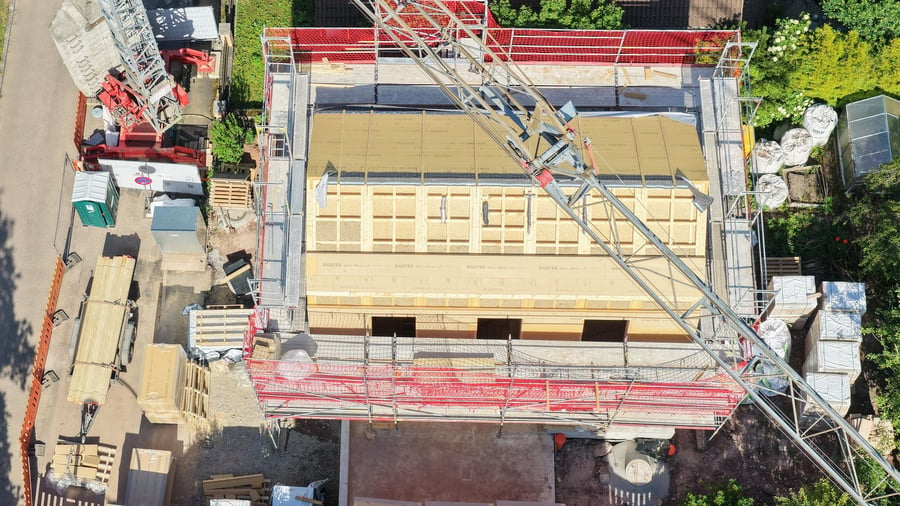
Extreme low water levels on the Rhine and other rivers have consequences for construction companies. With cargo ships carrying fewer passengers, deliveries to the construction industry are being delayed, as high material prices are further exacerbated. "We can observe that water transport becomes increasingly difficult," said Thomas Reimann, president of the Hessian Builders' Association.
"This also causes problems for the construction of multi-family homes or schools, as delivery times are extended." Sand and gravel, which are often transported by ship in large quantities to concrete factories, are becoming scarcer and therefore more expensive. While the price rise may be manageable for now, building materials and especially transportation have already become significantly more expensive in recent years.
"We are experiencing the third price increase within a few years, following the energy crisis in Ukraine and the Iran conflict," Reimann said. "And historically, many price hikes remain permanent." Ship transportation is hard to replace The Building Industry Association warns of the consequences of low water levels. "Delivery bottlenecks for basic building materials have already been announced by suppliers in case the situation persists for a longer period, which can be assumed at the moment."
Due to the low water levels, transport capacities for important construction materials that are transported in large quantities by ship have shrunk, including bitumen, gravel and natural stones, as well as fuel and mineral construction waste. "In the worst case, additional ships may be needed or deliveries may have to be shifted to rail and road," said Tim-Oliver Müller, CEO of the HDB.
"But this is only limitedly possible and often much more expensive." Material and logistics costs could rise Construction of projects could lead to higher material and logistics costs, and in the worst-case scenario, delays in the construction process. While it may not result in a complete halt on construction sites, the risk of bottlenecks, higher logistics costs, and delays increases the longer the low water levels persist.
Rising construction costs, which have accelerated this year according to the Federal Statistical Office, are a significant reason why the housing market is slowing down. Germany is estimated to be missing around one million homes, which is driving up rents, especially in cities. Construction costs have risen to "an unimaginable level," criticized Federal Minister of Construction Verena Hubertz in Frankfurt, and several countermeasures have been announced.
Recycling building materials as a solution? Reimann, a construction entrepreneur himself, sees more sustainability in construction as an opportunity to respond to rising prices due to low water levels. Many building projects have already calculated that they can no longer afford the increased interest rates and expensive materials.
"One solution would be to avoid tearing down buildings and leave the shell intact," he suggested. More empty offices could be converted into housing and more recycled building materials used. However, legal hurdles stand in the way. "As long as we classify recycled building materials as waste in Germany, we will not be able to convince builders to use them in their homes."
Recycling building materials, such as those obtained from construction waste, are classified as waste. Even some concrete types incorporate recycled material, but demand is low. The public sector needs to lead the way by issuing more tenders for recycled building materials, says Reimann. "The billion-euro reserves for infrastructure present a significant opportunity."
Legal hurdles HDB CEO Müller sees sustainable construction as an important lever to increase resource efficiency. However, recycling building materials are far from sufficient to address the major challenges such as housing, infrastructure, and energy transition. "Additionally, it is often the public sector that explicitly excludes the use of recycled building materials in their tenders."
Moreover, recycling building materials may become more expensive and difficult to transport due to low water levels at the moment. Sustainable solutions are therefore not a short-term answer to the current problems. Müller calls for the removal of bottlenecks in the Middle Rhine, which could improve the transport capacity and predictability of barge traffic under low and medium water levels, but cannot prevent extreme low water levels.
Written by urgent.news from Handelsblatt's reporting — not their text. Machine-written — may contain errors; check the original before relying on it.