Urgent.News

One page, thousands of outlets. See who else covered it.

Editions

Science

NASA's SkyFall Mars Helicopters Will Feature a Revolutionary Antenna Design

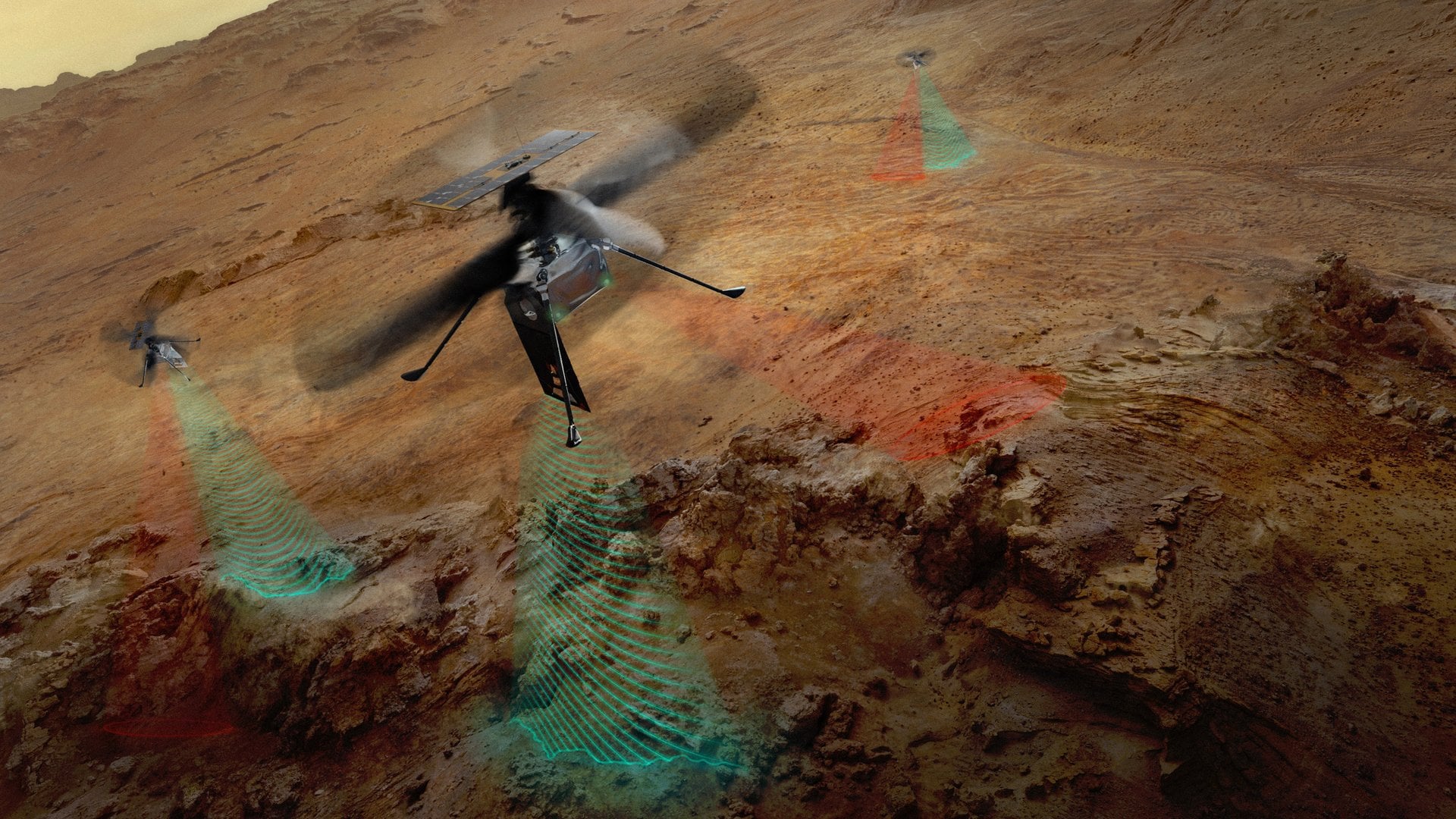
Engineers developed a unique fabric-based design for a ground-penetrating radar that will be a key instrument on NASA’s SkyFall Mars helicopters. The hardware will enable the SkyFall mission’s trio of planetary rotorcraft to use ground-penetrating radar to study the Martian subsurface.
NASA's SkyFall Mars Helicopters Will Feature a Revolutionary Antenna Design

NASA is set to launch a groundbreaking trio of Mars helicopters, known as SkyFall, in 2028. These helicopters will be equipped with a revolutionary antenna design to detect shallow subsurface ice deposits crucial for future astronaut missions. The innovative Vivaldi antenna, a flat, lightweight, and flexible antenna, will be able to penetrate several meters below the Martian surface while meeting clearance constraints.

Rigorous testing has demonstrated the antenna's resilience to landing impacts, temperature fluctuations, and radio-frequency performance. Once fully flight-qualified, SkyFall will explore Mars aboard humanity's first nuclear-powered interplanetary mission.

Written by urgent.news from Universe Today's reporting — not their text. Machine-written — may contain errors; check the original before relying on it.

Read the original at universetoday.com →

More in Science

Engineered E. coli convert kimchi radish waste into biodegradable bioplastic

Engineered E. coli convert kimchi radish waste into biodegradable bioplastic

Every year, thousands of tons of radish by-products generated during kimchi production are discarded despite containing valuable carbon and nutrient resources. Researchers at the World Institute of Kimchi (WiKim) have developed a genome-scale model-guided microbial engineering strategy that enables these agricultural by-products to be…

Modeling Planetary Magnetism Lab

This interactive lab activity engages advanced students in investigating planetary magnetic fields using physical models and smartphone sensors, bridging physics and planetary science.

  • Lab teaches planetary magnetic fields through hands-on activities
  • Students compare Earth and Mars magnetic properties
  • Last updated October 7, 2025 by AAPT
Andrew Wartenberg

Andrew Wartenberg

Pathways Intern, Student Trainee (Engineering) – Aeronautics Systems Analysis Branch (ASAB)Systems Analysis and Concepts Directorate (SACD) The post Andrew Wartenberg appeared first on NASA Science .

More from Monday 17 August →