How an ancient collision with another galaxy transformed the Milky Way
The Milky Way has a secret history of galaxy mergers that we are only now starting to uncover.
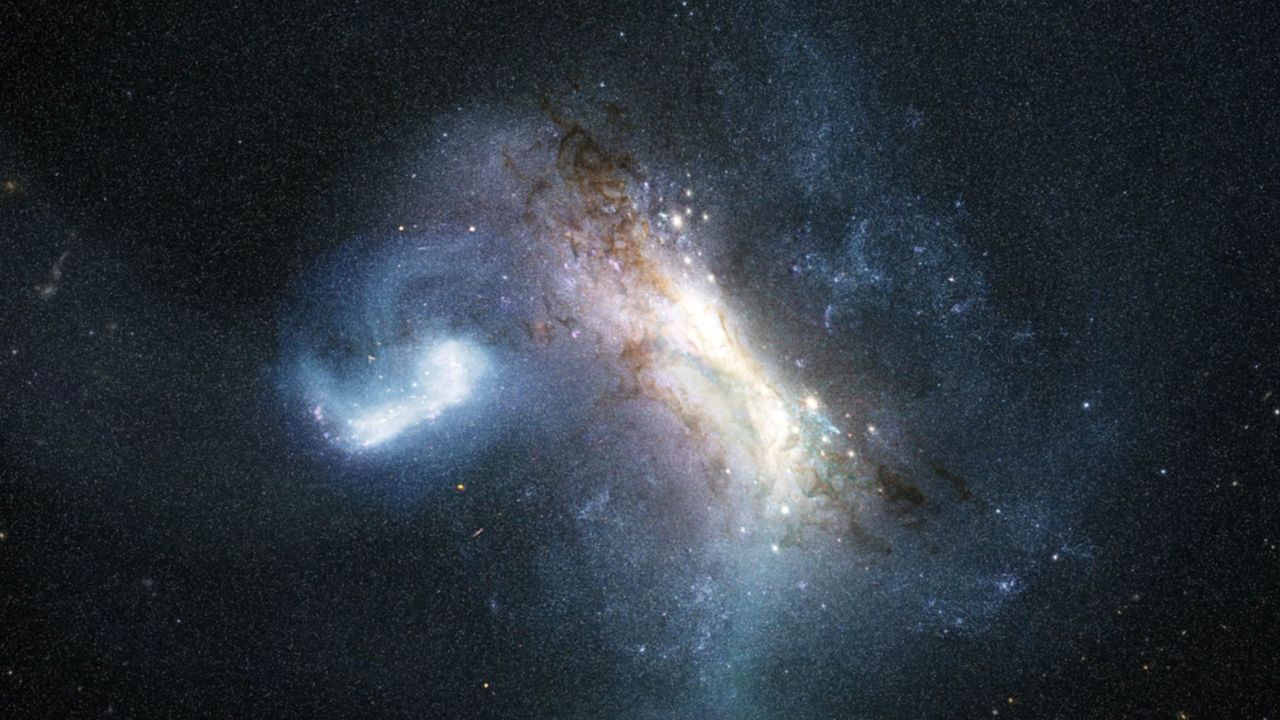
Evidence has emerged that our Milky Way galaxy underwent a substantial collision and merger with a smaller galaxy 11.8 billion years ago, according to findings from the Hubble Space Telescope. Galaxy mergers typically contribute to the growth of galaxies; however, understanding our Milky Way's history necessitates meticulous analysis.
The Milky Way, our home, has an unknown origin story, according to Davide Massari, a lead author from the Astrophysics and Space Science Observatory of Bologna in Italy. This research identifies the origin of the first significant batch of bricks – a dwarf galaxy called LKH, which stands for Low-energy–Kraken–Heracles. LKH is a reference to three earlier research papers that speculated about mergers early in our galaxy's history.
Prior to this study, another significant merger with a galaxy named Gaia–Sausage–Enceladus (GSE) around 10 billion years ago was documented. The GSE galaxy possessed globular star clusters that integrated with the Milky Way's clusters following the collision. Massari's team has now discovered a separate population of globular clusters that do not originate from the Milky Way or the GSE galaxy but arrived 11.8 billion years ago, preceding the GSE merger.
Utilizing Hubble's high-resolution imaging, astronomers measured the age and metal content of these clusters with exceptional precision. These clusters are distinct from the others, having originated in LKH and revealing when this galaxy was absorbed by the Milky Way. The team calculates that LKH had a mass of 500 million times the mass of our sun, slightly larger than the Sagittarius Dwarf galaxy currently being absorbed by the Milky Way and about one-tenth the mass of the Small Magellanic Cloud.
At the time of the collision, our galaxy was considerably smaller, and LKH contributed substantially to its mass in terms of stars, gas, and dark matter. This discovery adds a crucial new event to the Milky Way's history, influencing its evolution, such as sparking a new wave of star formation and altering the chemistry of stars as they died and dispersed their remains into the interstellar medium to create new stars.
Written by urgent.news from Space.com's reporting — not their text. Machine-written — may contain errors; check the original before relying on it.
This story
This is one outlet's version. Read the fullest account.