Massive Exoplanets Could Form Around Supermassive Black Holes
Black holes aren't just engines of inexorable destruction. They're complex regions of space and time, and under the right conditions, giant planets can form in their AGN disks.
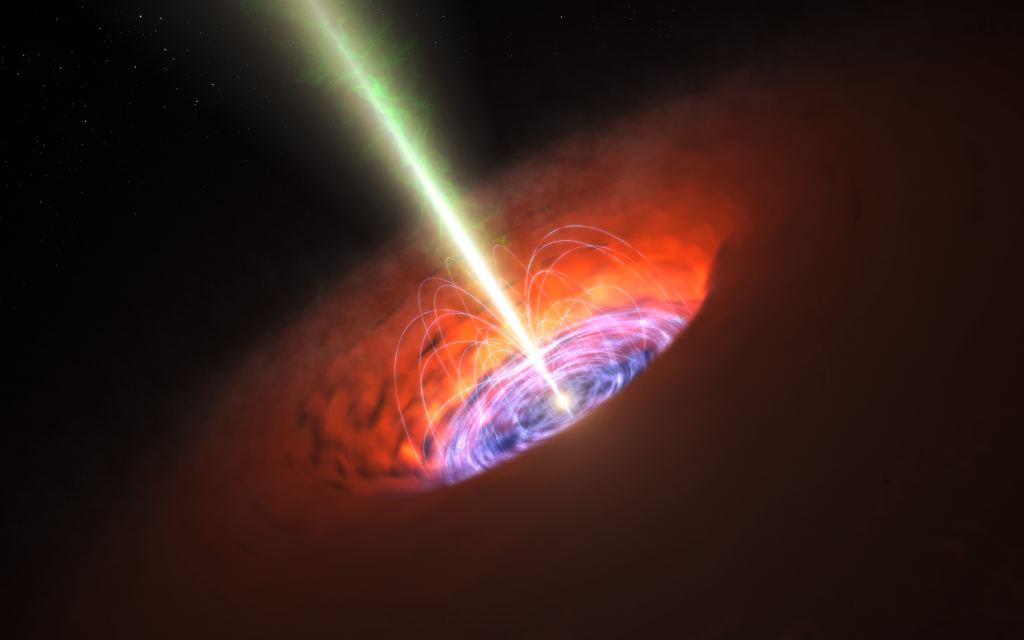
Supermassive black holes (SMBHs) are often depicted as cosmic vacuum cleaners, devouring any matter that ventures too close. However, new research reveals a more intricate picture, showing that the accretion disks surrounding SMBHs can actually foster the formation of massive planets. The key lies in the fact that these disks are often strongly magnetized, stabilizing the disk and countering turbulence, allowing for planet formation.
The outer regions of these accretion disks, which are significantly cooler than the inner regions, have temperatures similar to the surrounding circumstellar disks, enabling dust condensation. This environment can facilitate the formation of giant planets, potentially even those exceeding the hydrogen-burning limit, through a process called streaming instability.
This instability occurs when dust grains become large enough to drag gas along with them, preventing the gas from spiraling into the SMBH and allowing for the formation of planetesimals. The authors predict the existence of exotic, dust-dominated exoplanets with core masses above the hydrogen-burning limit, which could eventually evolve into stars or even black holes under certain conditions.
However, detecting these massive objects would be challenging due to their tendency to sink inward towards the SMBH, leading to a mass segregation effect. Nonetheless, the potential for forming Jupiter-mass planets, stars, and even intermediate-mass black holes makes SMBH accretion disks compelling sites for the birth of diverse celestial bodies.
Written by urgent.news from Universe Today's reporting — not their text. Machine-written — may contain errors; check the original before relying on it.