In a First, Astronomers May Have Spotted a Galaxy in the Early Universe With Three Behemoth Black Holes
The galaxy’s light took about 12.5 billion years to reach the James Webb Space Telescope, meaning the instrument saw the black holes a little more than one billion years after the Big Bang. Two of the black holes seemed on track to merge, illustrating how the objects grow
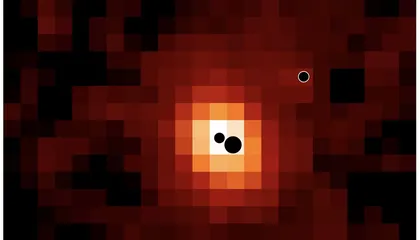
Astronomers have potentially discovered an exceptionally distant galaxy, containing three supermassive black holes, at the dawn of the universe. This groundbreaking observation, published in the journal Astronomy & Astrophysics on August 12, marks the first time such a black hole triplet has been spotted so soon after the Big Bang. The discovery provides valuable insights into the formation and growth of these enigmatic celestial objects, particularly in the early cosmos.
The research team, led by astrophysicists Hannah Übler and Giovanni Mazzolari at the Max Planck Institute for Extraterrestrial Physics, utilized the James Webb Space Telescope (JWST) to study an extremely distant galaxy called J0148-4214. By analyzing the galaxy's light emissions, the team identified two black holes near each other, separated by a mere 620 light-years. The presence of a third black hole, located approximately 5,500 light-years from the other two, further strengthened the findings.
The largest of the three black holes, with a mass equivalent to 80 million suns, appears to be actively accreting matter at a rate faster than previously theorized. The smaller, nearby black hole, with a mass of 0.6 million suns, also shows accelerated accretion, potentially violating current growth models. The third, more distant black hole, with a mass of two million suns, is believed to be a lone entity that may eventually merge with the others or have been displaced during an earlier cosmic event.
This discovery sheds light on the efficiency of processes at work in the early universe, suggesting that black holes were more prevalent and rapidly growing than previously thought. The findings offer a unique window into the formation and merger of supermassive black holes during the epoch of cosmic dawn, approximately 13.8 billion years ago.
Written by urgent.news from Smithsonian's reporting — not their text. Machine-written — may contain errors; check the original before relying on it.