China adds an 800-passenger jet with ‘flying wing’ body to its big aircraft plan
A Chinese research team has unveiled an aerodynamic model for a massive flying-wing passenger aircraft that could carry more than 800 people, marking a bold new entry in the country’s large aircraft programme. Unlike conventional aircraft that have separate fuselage, wings and tail, a flying wing merges most of the structure into a single broad lifting body. The proposed design is 85 metres (280…
Chinese researchers have unveiled a groundbreaking aerodynamic model for a colossal flying-wing passenger aircraft capable of accommodating over 800 passengers, marking a significant expansion in China's large aircraft program. Unlike traditional aircraft with distinct fuselage, wings, and tail, this innovative design integrates most components into a single, broad lifting body.
The proposed configuration boasts an impressive 85-meter (280-foot) width and 43-meter (141-foot) length, with a wingspan roughly 1.6 times larger than that of the B-2 Spirit stealth bomber, which also employs a flying-wing layout. In comparison, the current largest passenger jet, the Airbus A380, typically accommodates approximately 555 passengers.
Developed by the China Aerodynamics Research and Development Centre (CARDC), a national institute involved in major aircraft projects like the C919 narrowbody airliner and the Y-20 transport plane, this concept pushes the boundaries of civil aviation. Although the aircraft has yet to receive a public name, it is being hailed as a pioneering project exploring even more radical configurations.
The high-aspect-ratio flying wing is touted for its remarkable aerodynamic advantages, including a high lift-to-drag ratio and low induced drag, which could result in longer range and reduced energy consumption. Originally conceived for a 250-seat aircraft, the design has been scaled up to the 800-passenger class as part of China's broader push for large twin-aisle widebody airliners initiated during the 13th Five-Year Plan.
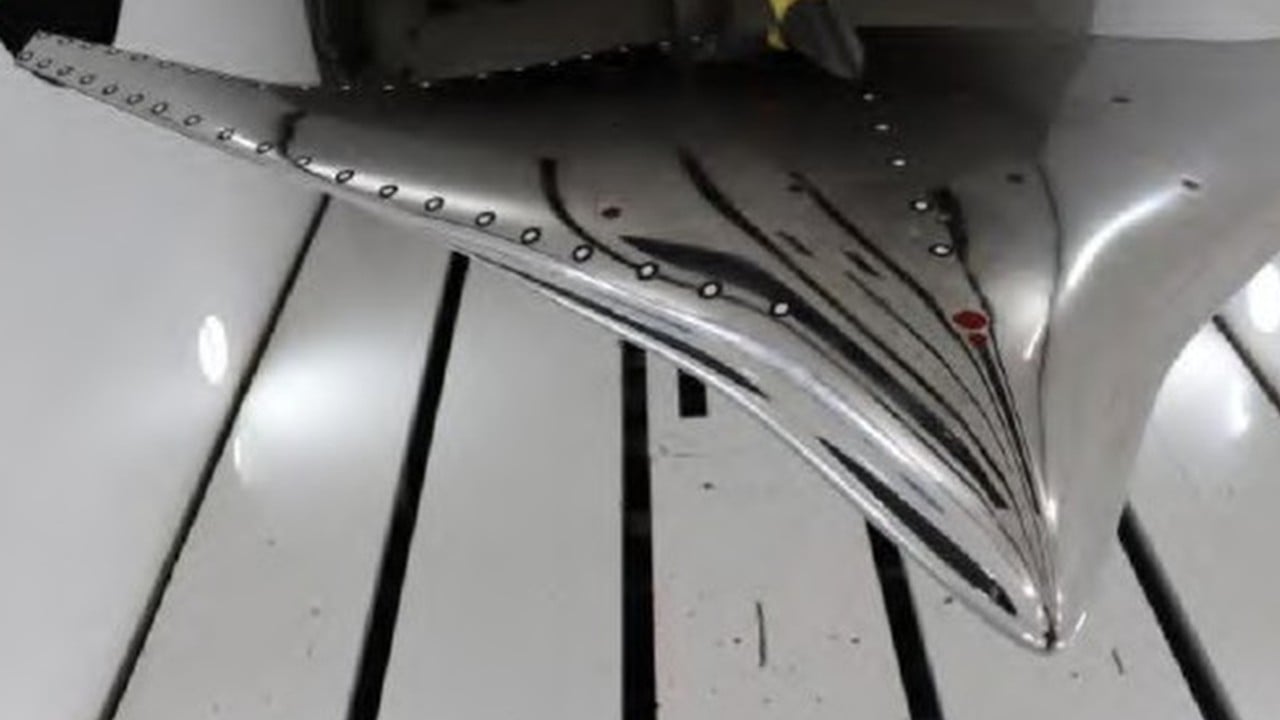
The final design features a reference wing area of about 1,395 square meters (15,015 square feet), a 37-degree leading-edge sweep, and a 28-degree trailing-edge sweep, with an expected cruise speed of Mach 0.8. While a full-scale aircraft has not been constructed, the team is progressing with prototype testing using a 1:52 stainless-steel scale model measuring 0.8 meters in length and 1.6 meters in wingspan.
This model has undergone rigorous testing in CARDC's 2.4-meter transonic wind tunnel at speeds ranging from Mach 0.4 to 0.8, examining critical aerodynamic characteristics and structural behavior.
Written by urgent.news from Reuters Business via SCMP's reporting — not their text. Machine-written — may contain errors; check the original before relying on it.