Urgent.News

What's breaking now, across thousands of outlets.

AI

๐Ÿ”ฎ The curious economics of a $6 AI agent #597

Amazon spent some $1.8 million on a Claude project that ran unnoticed for five months. โ€œItโ€™s difficult to figure out how much anything [AI-related] costsโ€.

๐Ÿ”ฎ The curious economics of a $6 AI agent #597

Good morning from London. The AI spend of your nightmares has hit $1.8 million for Amazon's Claude project, which ran for five months. A senior employee admitted that it's hard to determine the exact cost of AI-related expenses.

One of the authors experienced a similar situation with their OpenClaw agent, R Mini Arnold. The costs for this bot increased as it grew more complex, and it took time to switch to cheaper models. The bot once blew through $500 a day, leading to a tedious audit that revealed many processes were running older, more expensive models like Opus 4.5.

The price war between Anthropic and OpenAI, in response to Chinese advancements, has helped bring costs down. RMA, the bot, now uses the author's token allowance from their $200-a-month subscription and falls back to cheaper models such as DeepSeek v4 Flash or Pro if OpenAI is unavailable. For harder tasks, RMA can use OpenAI's top model, 5.6 Sol, or Anthropic's Fable, both of which are paid for by the token.

RMA is cheaper than before but more capable, as it plugs into the Manus API for certain tasks, uses Claude Code and Codex for coding, and has access to Prism (the internal research graph) and Elicit for academic papers. Despite the drop in costs, RMA still costs the author $2,000 per year.

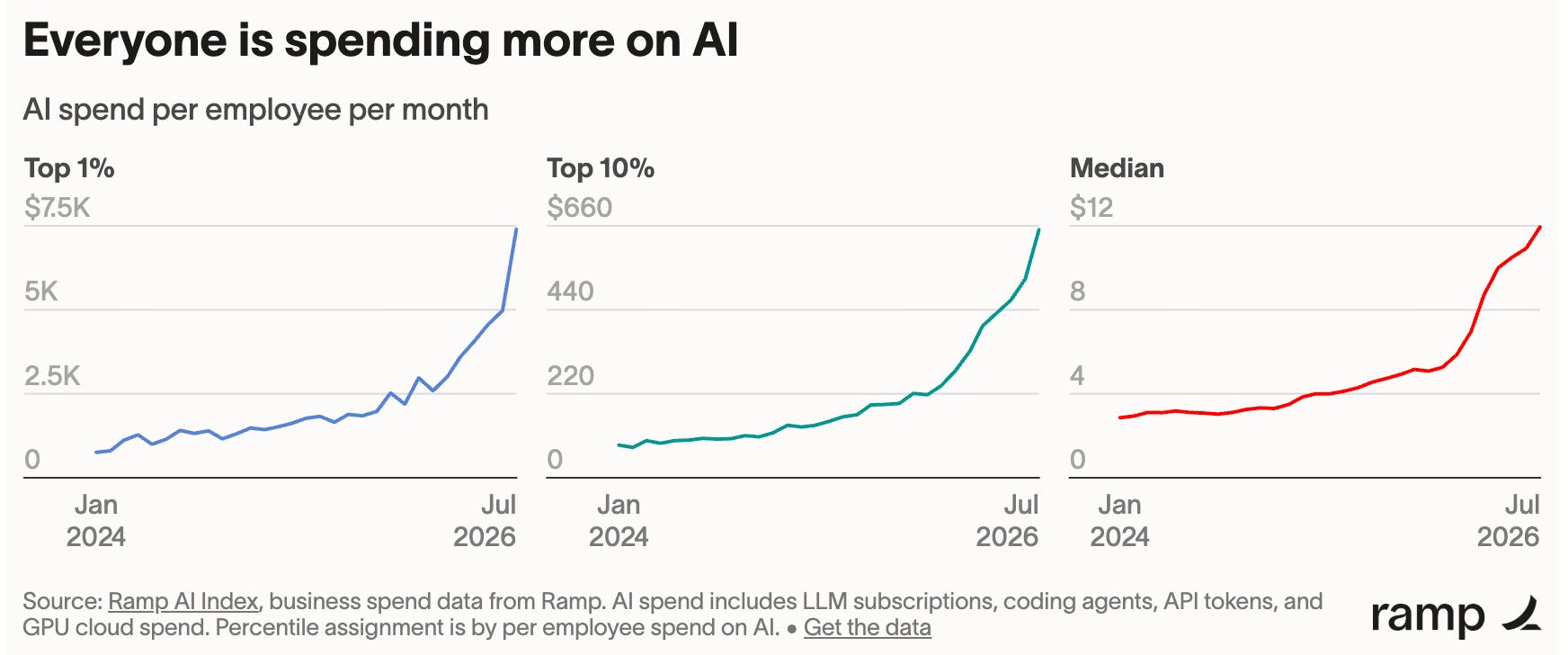
The author wonders if the $494 a day spent on AI has disappeared from revenue, but acknowledges it was just an anomaly. In July, top companies spent a median of $7,400 per employee on AI, with the top 10% spending $650. The median firm spent $11.95 per employee.

Written by urgent.news from Exponential View's reporting โ€” not their text. Machine-written โ€” may contain errors; check the original before relying on it.

Read the original at exponentialview.co โ†’

More in AI

Researchers have found that artificial intelligence (AI) models can easily decode encrypted data, raising concerns about potential personal data breaches. A team of researchers from the University of California, Berkeley, and the Massachusetts Institute of Technology (MIT) recently published a study on this issue. The researchers tested various AI models, including those using machine learning and deep learning techniques, to see if they could decode encrypted data. They found that some AI models were able to decode encrypted data with surprising accuracy, even when the data was encrypted using secure protocols. The researchers used a type of encryption called "homomorphic encryption," which allows computations to be performed on encrypted data without decrypting it first. However, they found that some AI models were able to bypass this encryption and decode the data with a high degree of accuracy. This raises concerns about the potential for personal data breaches, as encrypted data is often used to protect sensitive information such as financial data and personal identifiable information. The researchers warned that this vulnerability could be particularly problematic for organizations that rely heavily on AI and machine learning. "As AI models become more widespread, it's essential that we develop more robust security measures to protect sensitive data," said one of the researchers. The study's findings highlight the need for further research into the intersection of AI and cybersecurity. The researchers plan to continue exploring this issue and developing new methods for protecting encrypted data from AI-powered attacks. In the meantime, organizations are advised to exercise caution when using AI models to handle sensitive data. They should also consider implementing additional security measures, such as multi-factor authentication and secure data storage, to protect against potential data breaches.

More from Sunday 16 August โ†’