Japan’s mission to Mars’ moons seeks clues to origins of Solar System, life on Earth
TOKYO, Aug 17 — Japanese scientists are readying a mission to Mars’ moons to retrieve samples tha...
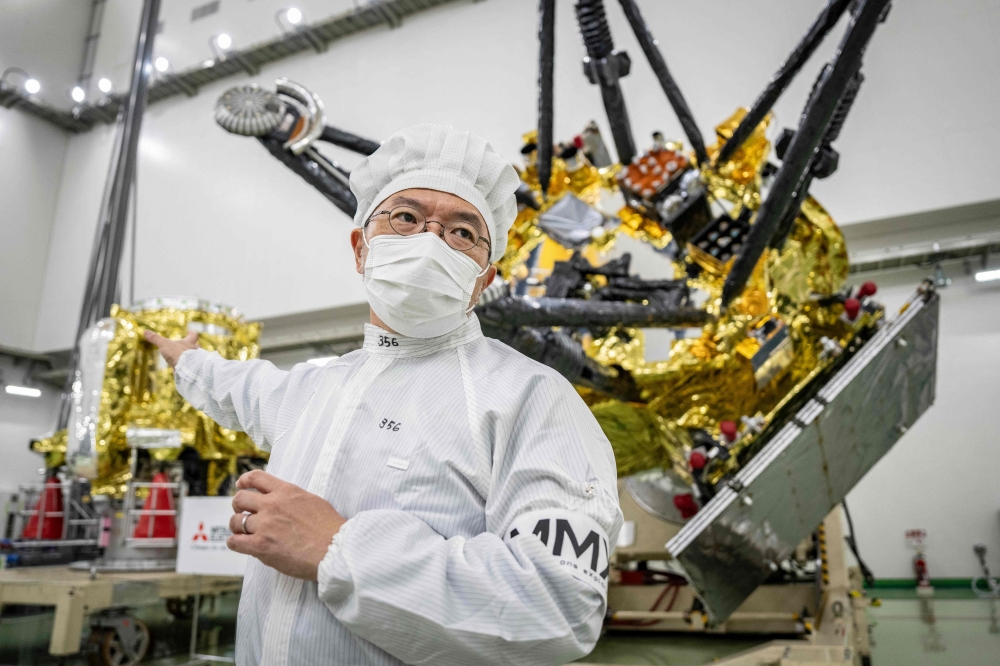
Japan is preparing a mission to investigate the Martian moons, Phobos and Deimos, with the aim of uncovering clues about the origins of the Solar System and the emergence of life on Earth. The unmanned Martian Moons eXploration (MMX) spacecraft is set to launch from Tanegashima Space Center in the coming months, with a planned lifespan of three years in Mars' orbit.
During this time, the mission will attempt to land on Phobos, collect at least 10 grams of material from its surface, and conduct surface observations using the French rover, IDEFIX.
The primary objective of MMX is to determine the formation process of Mars and its moons, providing valuable insights into the birth of the Solar System. Two theories currently exist for the origin of the Martian moons: the "giant impact" hypothesis and the "capture" hypothesis. The former suggests that the moons formed from debris following a collision with Mars, while the latter proposes that they are asteroids from the outer Solar System that were captured by Mars' gravity.
Identifying which theory holds true will contribute to understanding how habitable environments for life may have developed on Earth-like planets.
Patrick Michel, a French astrophysicist working on IDEFIX, emphasized the mission's potential to shed light on the transport mechanisms responsible for delivering water, volatiles, and organic compounds from the outer Solar System to the inner rocky planets. If Phobos and Deimos are indeed remnants of early delivery systems, they could hold crucial information regarding the origins of life on Earth and other habitable worlds.
MMX is a collaborative effort involving Japan's National Aerospace Development Agency (JAXA), France's National Centre for Space Studies (CNES), Germany's Aerospace Center (DLR), NASA, and several European Space Agency (ESA) partners, as well as numerous universities and technology companies. Developing the spacecraft's landing legs posed a significant challenge due to Phobos' extremely low gravity, according to Akinari Uehara, a Mitsubishi Electric engineer involved in the project.
However, Japan has previously demonstrated its capability in bringing back samples from space, most notably through the successful Hayabusa-2 mission that returned asteroid samples to Earth in 2020.
Written by urgent.news from Malay Mail's reporting — not their text. Machine-written — may contain errors; check the original before relying on it.