Inside the Experimental Traps Scientists Set for Ghostly Neutrinos
Observatories have been built in mines, deep under the Antarctic ice sheet, and elsewhere in an effort to detect the fleeting particles.
For more than two and a half decades, scientists had been perplexed by a phenomenon in which energy seemed to vanish during a radioactive process known as beta decay. Something appeared to be missing, and there was no established physics to account for it. In 1930, Austrian physicist Wolfgang Pauli proposed a bold explanation: a nearly undetectable particle was surreptitiously carrying away the missing energy.
Pauli admitted, "I have done a terrible thing—I have assumed a particle that cannot be detected." This elusive particle would later be dubbed the neutrino. Neutrinos have almost no mass and no electrical charge, allowing them to traverse Earth and all of its contents with minimal interference. In 1956, physicists Kenneth Cowan and Frederick Reines sought to locate what Pauli deemed impossible.
Their massive apparatus, deployed in 1956, successfully detected neutrinos, spurring interest in utilizing these particles to observe nuclear reactions occurring in stars. A major challenge arose: how to capture particles that rarely collide with matter, given their ability to pass through almost anything undetected. The solution was to construct some of the largest, deepest, and most unconventional experimental setups in scientific history, and then patiently wait.
In the 1960s, Raymond Davis Jr. and colleagues at Brookhaven National Laboratory submerged a tank 1.5 kilometers underground in the Homestake mine in South Dakota and filled it with nearly 400,000 liters of a chlorine-based substance called perchloroethylene. When a passing neutrino collided with a chlorine nucleus, it transformed into a radioactive form of argon that could be detected and counted.
This 25-year-long experiment yielded only one-third of the anticipated neutrinos from the sun, a result known as the solar neutrino problem. It would take decades to resolve—through even more comprehensive experiments. In Japan’s Kamioka mine, Masatoshi Koshiba constructed a detector called Kamiokande, using 3 million liters of ultra-pure water.
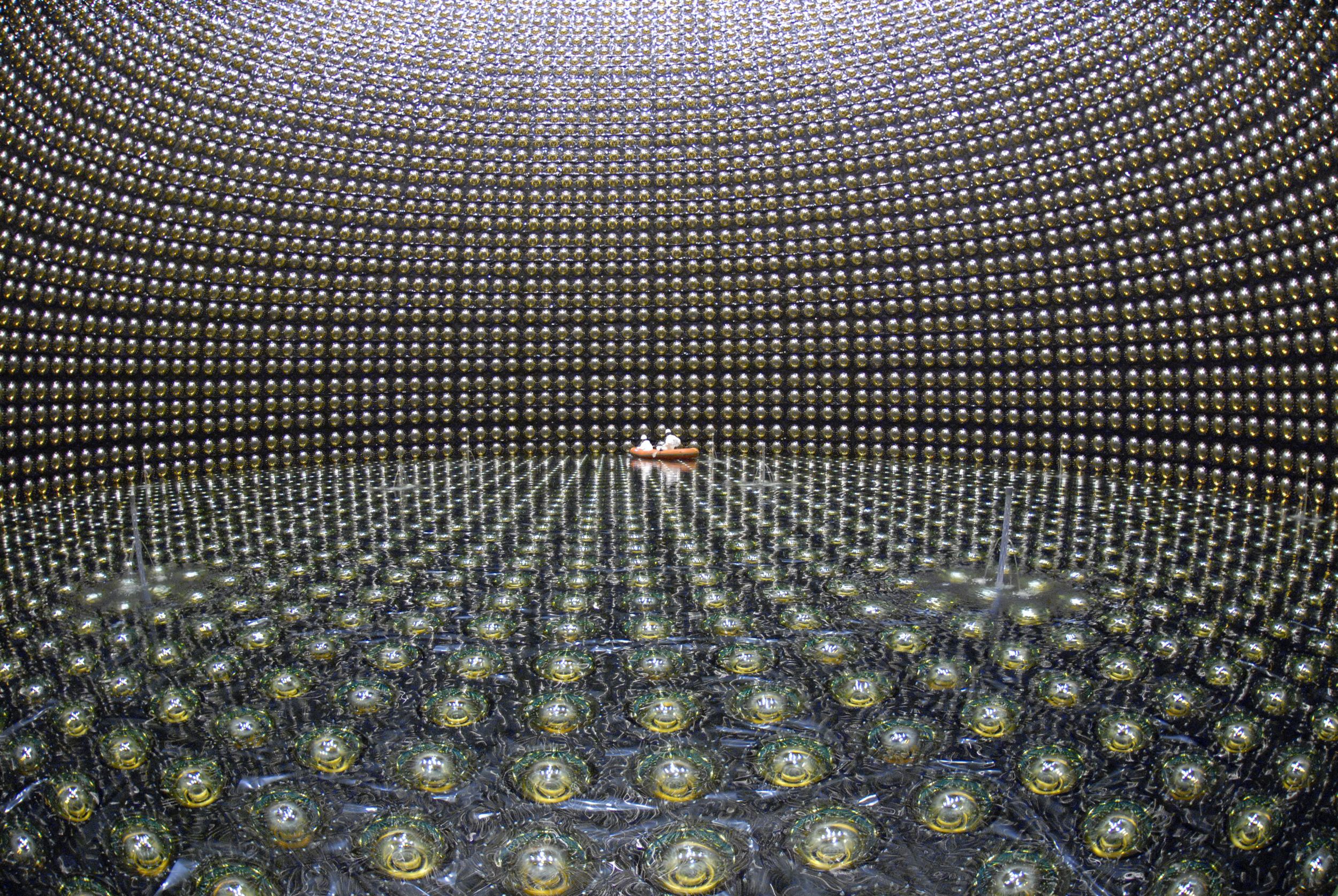
When neutrinos interact with atomic nuclei in the water, they generate an electron that travels swiftly, emitting a flash of light known as Cherenkov radiation. This light is detected by specialized instruments. Kamiokande, followed by an even larger detector named Super-Kamiokande, as well as Canada’s Sudbury Neutrino Observatory, verified Davis’ findings and confirmed that neutrinos have mass, a prediction the laws of physics had previously failed to make.
Modern neutrino detectors continue to push the boundaries of ambition and yield unexpected results. The IceCube Neutrino Observatory, located beneath the Amundsen-Scott South Pole Station, utilizes Antarctic ice instead of water, mapping the Milky Way exclusively through neutrinos and linking these high-energy cosmic particles to active galaxies powered by supermassive black holes.
Submerged in the Mediterranean Sea, the Cubic Kilometer Neutrino Telescope (KM3NET) has identified the most powerful cosmic neutrino ever recorded, though its origin remains unknown. Neutrino oscillations, and the numerous puzzles they present, have spurred the creation of the latest generation of detectors. China’s Jiangmen Underground Neutrino Observatory (JUNO) began operations in 2025, delivering the most precise measurements of neutrino oscillation to date in June 2026.
Japan’s Hyper-Kamiokande (Hyper-K) and the Deep Underground Neutrino Experiment (DUNE) in the American Midwest are scheduled to commence operation later this decade. Through these and other ambitious endeavors, the particle that Pauli was confident could never be captured has begun to unveil its mysteries. The recipe for discovery has remained constant over seven decades: think large, delve deep, and exercise patience.
Written by urgent.news from Wired's reporting — not their text. Machine-written — may contain errors; check the original before relying on it.