Urgent.News

650+ sources. One page. See who else covered it.

Editions

World

Activists remain wary as court narrows presidential insult provisions

The Constitutional Court’s recent ruling that alleged insults against the president or vice president can only be prosecuted upon their complaint has not quieted fears for free speech amid growing intimidation of critics.
Activists remain wary as court narrows presidential insult provisions

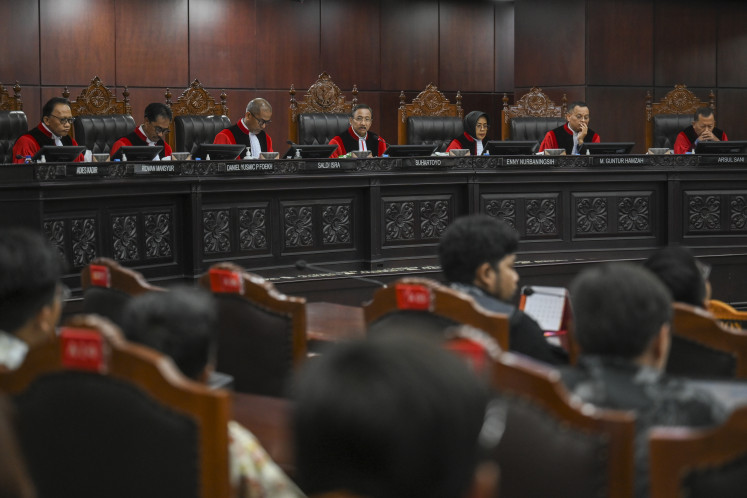
The Constitutional Court’s recent ruling limiting the prosecution of alleged insults against the president or vice president to their own complaints has not eased concerns about free speech amid increasing intimidation of critics. During a hearing on Wednesday, the nine-justice panel partially approved a petition challenging three articles of the new Criminal Code, which penalize offenses that may tarnish the honor or dignity of the president or vice president.

The 15-law students-led petition aimed to invalidate these provisions and clarify eligibility for filing complaints, arguing that legal uncertainty could stifle free expression. The Court recognized the ambiguity, ruling that insults against the president or vice president could only be prosecuted if the aggrieved party files a complaint.

It effectively prevents family members, supporters, and other third parties from filing such complaints on their behalf. Justice Guntur commented, "The decision is made so that there’s no room for other parties [...] to file a criminal proceeding based on their own judgment." Despite the ruling, the panel rejected the petitioners' request to nullify the three provisions, stating that defamation articles remained constitutional and could function as intended without violating free speech rights.

Written by urgent.news from The Jakarta Post's reporting — not their text. Machine-written — may contain errors; check the original before relying on it.

Read the original at thejakartapost.com →

More in World

North Korean leader Kim Jong-un has responded to a congratulatory message from Russian President Vladimir Putin on Korea's Liberation Day, calling him a "friendly friend" and expressing support for Russia's actions in Ukraine. Kim sent the message on August 15, which marks the anniversary of Korea's liberation from Japanese colonial rule in 1945, according to the official Korean Central News Agency. In his message, Putin congratulated Kim and the people of North Korea on the occasion, saying that Russia values its relations with North Korea. Kim responded by saying that he treasures the "comradely friendship" with Putin and considers him a "friendly friend". Kim also expressed his support for Russia's actions in Ukraine, saying that he highly appreciates Russia's "consistent and unwavering" stance on protecting its sovereignty and security. The exchange of messages comes as North Korea has been strengthening its ties with Russia, while trying to expand its diplomatic outreach amid international isolation over its nuclear and missile programs. North Korea has so far maintained a neutral stance on the Ukraine issue, but its support for Russia is seen as a way to strengthen its alliance with Moscow. The two countries have been cooperating on various issues, including trade and defense, and have also been exchanging high-level visits. In July, Russian Defense Minister Sergei Shoigu visited Pyongyang, where he and North Korean Defense Minister Kang Sun-nam agreed to strengthen military cooperation. The visit was seen as a significant development in the two countries' relations, which have been growing closer in recent years. North Korea has been facing increasing international pressure over its nuclear and missile programs, and has been seeking to strengthen its alliances with countries like Russia and China. The country has conducted several missile tests this year, including an intercontinental ballistic missile test in July. The tests have been condemned by the international community, and have led to increased tensions in the region. Despite the international pressure, North Korea has continued to pursue its nuclear and missile programs, citing the need for self-defense. The country's leader Kim Jong-un has said that the development of the country's nuclear capabilities is a top priority. Kim has also said that the country will continue to take steps to strengthen its defense capabilities, including the development of new missiles and other military technologies. The situation in North Korea remains a major concern for the international community, with many countries calling for the country to abandon its nuclear and missile programs. However, North Korea has so far refused to engage in talks on denuclearization, saying that it will not abandon its nuclear program unless the United States and other countries lift their sanctions. The standoff over North Korea's nuclear and missile programs continues, with no clear resolution in sight.

More from Sunday 16 August →