The Lakers’ record sale has another twist: Mark Walter’s brief tenure
If the $12.5 billion sale is approved, Walter’s Lakers tenure as owner would rank among the shortest USA TODAY identified across four major leagues.
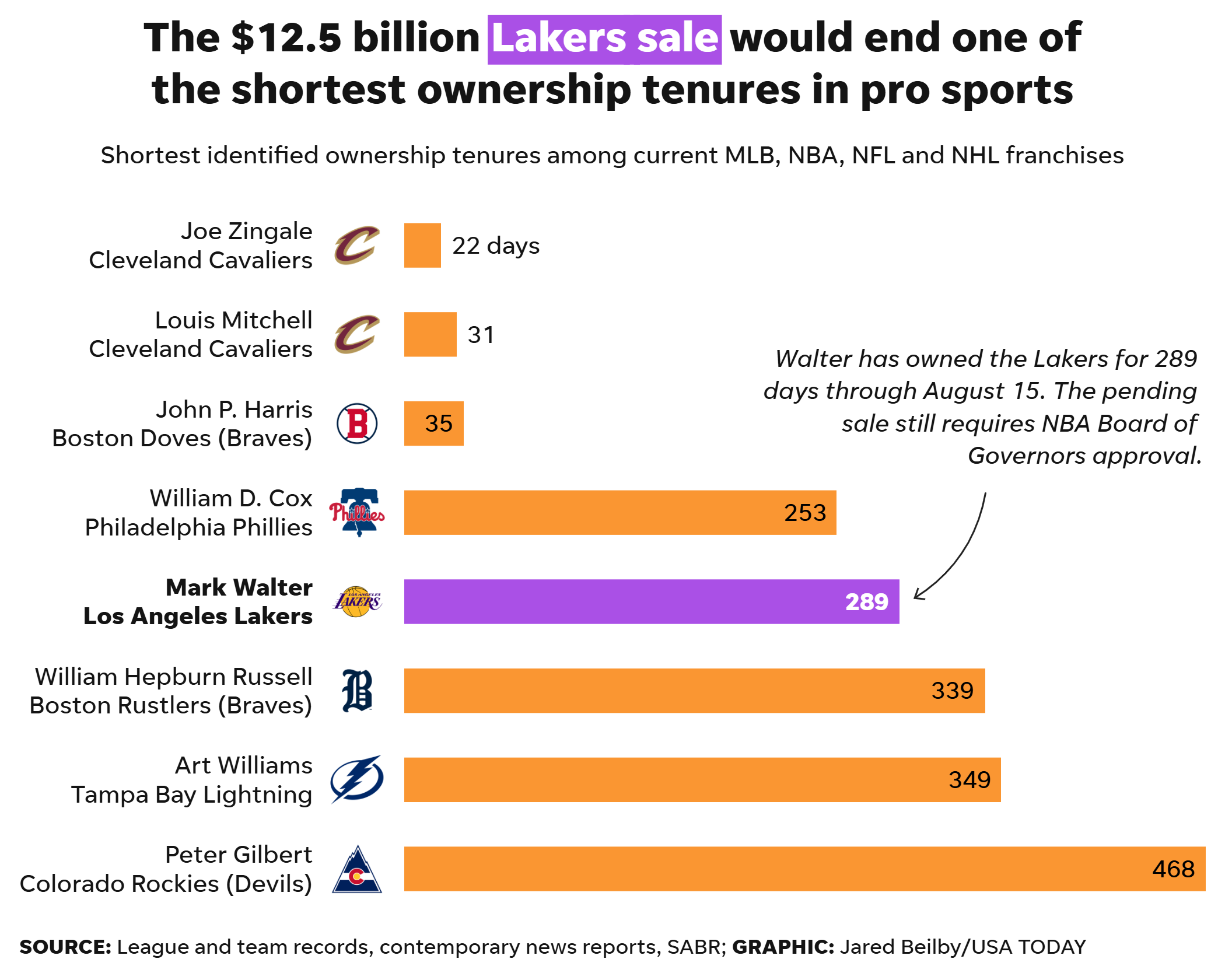
The blockbuster sale of the Los Angeles Lakers garnered attention not only for its staggering $12.5 billion valuation but also for a unique aspect: if approved by the NBA Board of Governors, Mark Walter's ownership could rank among the shortest in the histories of MLB, NBA, NFL and NHL franchises. USA TODAY analyzed ownership records across these four major U.S. leagues and identified only four instances of shorter qualifying tenures than Walter's 289-day span through August 15.
The briefest such periods were observed in the 1980s when the Cleveland Cavaliers underwent a quick ownership change between Nick Mileti and Joe Zingale within a 92-day span. Another notable case was John P. Harris's 35-day control of the Boston Doves in 1910. William D. Cox's 253-day ownership of the Philadelphia Phillies and the 289-day span of Mark Walter's potential ownership of the Lakers complete the top five shortest tenures.
However, Walter's ownership is currently pending approval, which could extend his tenure. The NBA's recent ownership sales have demonstrated significant variation in duration, with some transactions finalized in as little as 28 days. Thus, Walter's final tenure could range from approximately 315 days to 420 days. If the sale is not finalized before October 4, Walter may fall behind Bill Hepburn Russell, who owned the Boston National League franchise for 339 days until his death in November 1911.
Should the transaction not close by October 14, he would be surpassed by Art Williams, who owned the Tampa Bay Lightning for 349 days from July 1998 to June 1999. The article only considered standalone acquisitions and subsequent transfers of controlling ownership, excluding franchise swaps or inherited ownership changes.
Written by urgent.news from Yahoo Sports's reporting — not their text. Machine-written — may contain errors; check the original before relying on it.