Conspiracy theories falsely blame Colombia earthquake on Alaska research programme
Social media claims linking Colombia’s deadly earthquake to Alaska’s HAARP are false, with experts attributing the quake to natural tectonic activity.

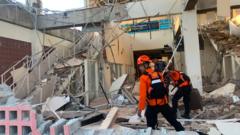
A 7.4 magnitude earthquake struck western Colombia on Monday, leaving at least 270 people dead and causing widespread damage. Conspiracy theories have resurfaced on social media, falsely blaming the US research program HAARP, located in Alaska, for the disaster. However, experts confirm that the earthquake was caused by natural movements in the Earth's crust, specifically "strike-slip faulting," and had no connection to human activities.
Suzan Van der Lee, a seismologist at Northwestern University, emphasized that the earthquake occurred in a region with many natural earthquakes and that there are instances where human activity, such as gas extraction or waste water injection, has caused small- to moderate-magnitude earthquakes. Nonetheless, the Colombian earthquake was at a depth of 110 kilometers, significantly deeper than any caused by human activities.
The High-frequency Active Auroral Research Program (HAARP) has been the subject of conspiracy theories since its construction began in the early 1990s. While HAARP studies the properties and behavior of the upper atmosphere, focusing on the thermosphere and ionosphere with high-frequency radio transmitters, its Ionospheric Research Instrument (IRI) is not capable of causing earthquakes.
Geophysicist Dean Whitman from Florida International University dismisses the claims as "ridiculous," pointing to the immense energy released by the earthquake, which is much larger than any energy produced by HAARP, and the fact that HAARP's equipment is pointed upward, not downward towards earthquake-prone areas.
Written by urgent.news from Hindustan Times - World News's reporting — not their text. Machine-written — may contain errors; check the original before relying on it.
This story
This is one outlet's version. Read the fullest account.