Bright planets can blind the Webb telescope. A fix is coming.
New “superstripe” software lets the James Webb Space Telescope capture sharper images of bright planets and stars without overexposure.
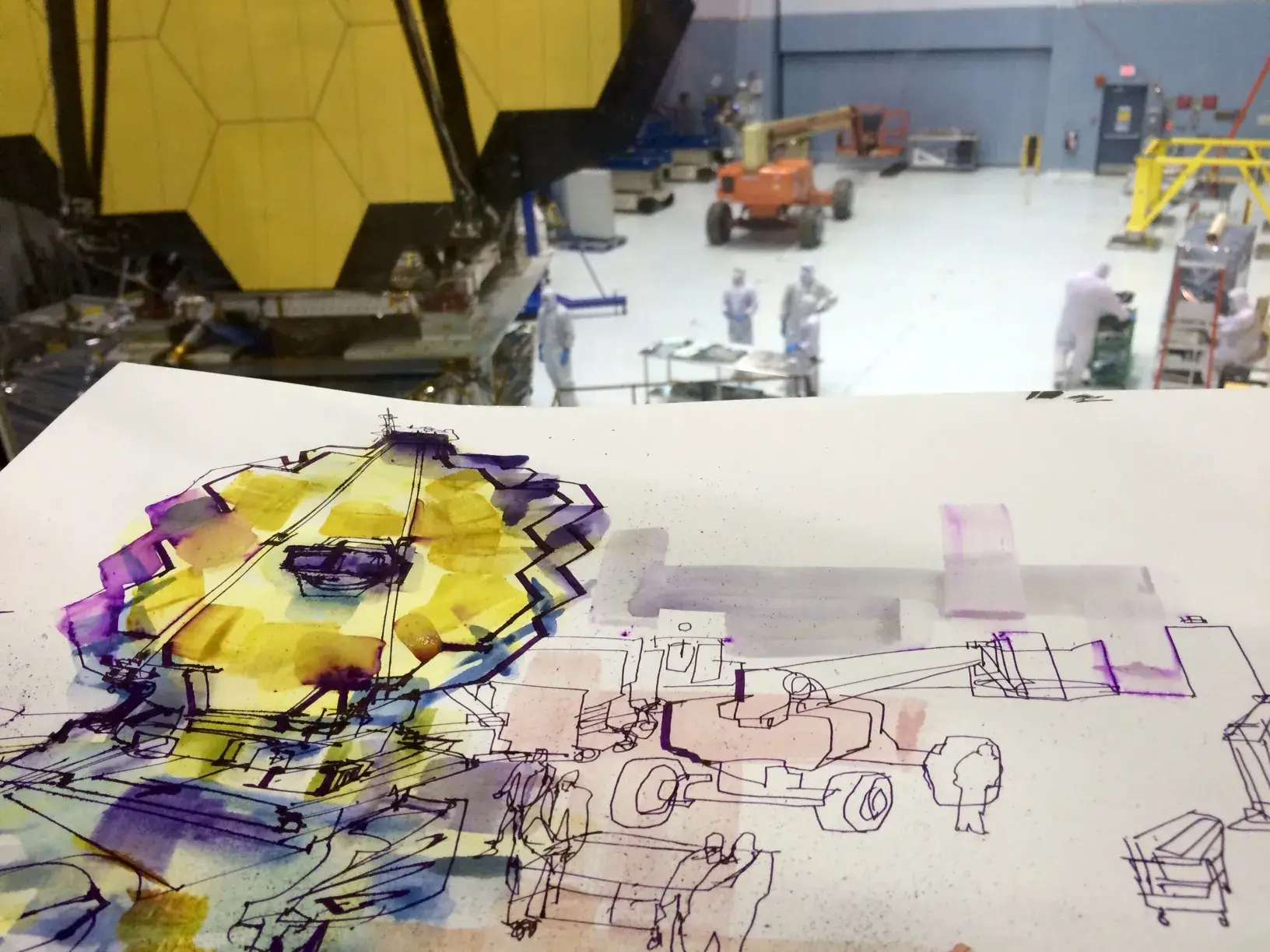
The James Webb Space Telescope, a joint project between NASA and its European and Canadian counterparts, is an infrared observatory designed to detect the faintest light in the universe, including light from ancient galaxies and stars formed just a few hundred million years after the Big Bang. However, its immense sensitivity presents a challenge when photographing bright objects within our own solar system.
The planets Mars and Saturn, for instance, overwhelm the telescope's sensors with their brightness, rendering images blurry and overexposed.
To overcome this limitation, astronomers have resorted to using dark filters, much like wearing solar eclipse glasses, to protect the camera. Now, a workaround has emerged in the form of a software update called "superstripe." This technique allows Webb to photograph bright planets without discarding valuable data. Unlike previous methods that involved cropping the camera's view or taking long exposures to limit light exposure, superstripe enables the camera to scan the planet in thin slices, capturing rapid glances that are less susceptible to being dazzled by glare.
Each individual slice is recorded in a fraction of a second, minimizing the impact of any changes in extraterrestrial conditions that could blur the image.
After stitching the slices together, a single crisp picture emerges, vastly improving the clarity of what was once a blurry mess. This new method allows Webb to safely capture images of objects up to 100 times brighter than previously possible. While sharp image processing software can enhance certain aspects of the photos, it cannot recover light that was never recorded.
The superstripe technique represents a significant upgrade, as it captures each individual slice in a fraction of a second, preventing dazzle from the bright light.
This advancement is particularly exciting for astronomers who wish to study nearby worlds within our solar system. Webb's location in space, free from Earth's atmosphere, provides a unique advantage in observing distant cosmic phenomena. Advanced image processing software can improve the quality of these solar system images, but it cannot recover light that was never captured.
The superstripe technique could lead to new discoveries, such as clearer measurements of planets, moons, and their atmospheres, as well as the observation of exoplanets orbiting ultra-bright stars outside our solar system, like 55 Cancri e. This software update is set to be implemented in Webb's next observing cycle, beginning in July.
Written by urgent.news from Mashable's reporting — not their text. Machine-written — may contain errors; check the original before relying on it.