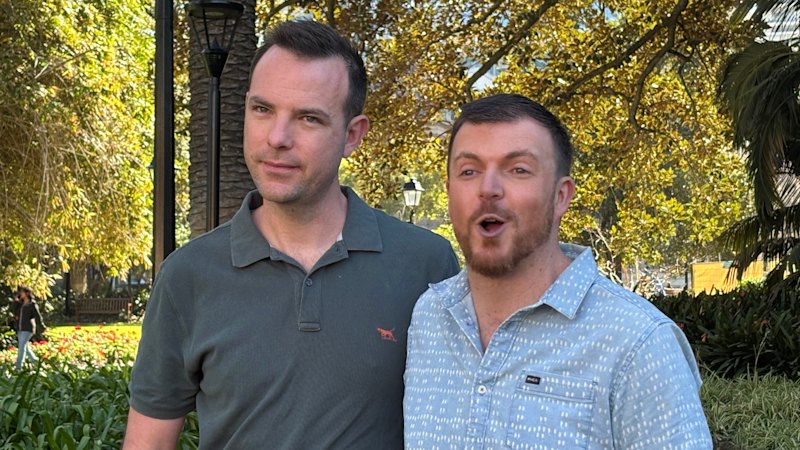
WA couple win Supreme Court battle to become same-sex parents through surrogacy
Trent and Brad Dunn fought an outdated West Australian law that said they could not be surrogate parents because they are a gay couple.
When India gained independence, there was no specific environmental policy in place. The Constitution of India contained a few provisions regarding the environment, but the term "environment" was not explicitly mentioned. In 1976, the Parliament incorporated ideas from the United Nations Conference on Human Environment held in Stockholm.
These provisions were added to the Constitution through the Constitution (forty-second amendment) Act, 1976. Article 48A is a directive principle of state policy, which advises the state to protect and improve the environment and to safeguard the forests and wildlife of the country. Article 51A is a separate provision within Part IVA, which outlines fundamental duties of citizens, urging them to protect and improve the natural environment.
Despite controversies surrounding the Amendments Act, the government at the time chose not to repeal many provisions. It was the Bhopal gas leak tragedy of 1984 that eventually prompted the Supreme Court to take action. The landmark case, Union Carbide vs Union of India, established the doctrine of absolute liability, which holds an enterprise responsible for harm caused by its inherently dangerous activities.
The polluter pays principle, introduced at the Rio Summit in 1982, was first applied in India in the case of Indian Council for Enviro-Legal Action vs Union of India. The Supreme Court further developed the precautionary principle, emphasizing that the state must anticipate, prevent, and address the causes of environmental degradation.
In my dissenting judgment in Vellore Citizens’ Welfare Forum vs Union of India, I argued that the precautionary principle is a cornerstone of environmental jurisprudence, while the polluter pays principle is merely a principle of reparation. The principle of sustainable development, as upheld in Vellore Citizens’ Welfare Forum, requires the state to balance environmental protection with development.
This principle has been accepted as customary international law. In M.C. Mehta vs Kamal Nath, also known as the Span Motel case, the Supreme Court introduced the concept of the public trust doctrine, holding that the government, not the private enterprise, is responsible for breaching the public trust. The Supreme Court has consistently emphasized the principle of inter-generational equity, which holds that the present generation has a duty to protect the environment for future generations.
While the Supreme Court has been a parent figure in nurturing environmental law, it has been questioned whether these decisions remain relevant today. Justice Gautam Patel has observed that while the Supreme Court has consistently supported the environmental cause, it has shown less support in cases challenging infrastructure projects. This inconsistency in the Court's decisions has exacerbated threats to the environment.
Written by urgent.news from The Indian Express's reporting — not their text. Machine-written — may contain errors; check the original before relying on it.
This story
This is one outlet's version. Read the fullest account.
- Trump asks Supreme Court to allow White House ballroom construction thehill.com
- Trump asks Supreme Court to allow ballroom construction rte.ie
- Trump asks Supreme Court to allow White House ballroom construction to continue livemint.com
- Supreme Court dismisses plea against A.P. HC order quashing land pooling scheme case against CM Naidu, Minister thehindu.com
- WA couple win Supreme Court battle to become same-sex parents through surrogacy theage.com.au
- Vipul Goyal to Samay's friend Balraj: Who are the other 4 who got Supreme Court relief over disabled persons remarks? hindustantimes.com
- After Supreme Court rebuke, now Bar Council berated by NALSAR students indianexpress.com