'The lance head was still inside the pelvis:' Mass grave found in Austria may hold casualties of unknown ancient Roman battle
A new analysis of skeletons recovered from an ancient mass burial has revealed a surprising number of groin injuries.
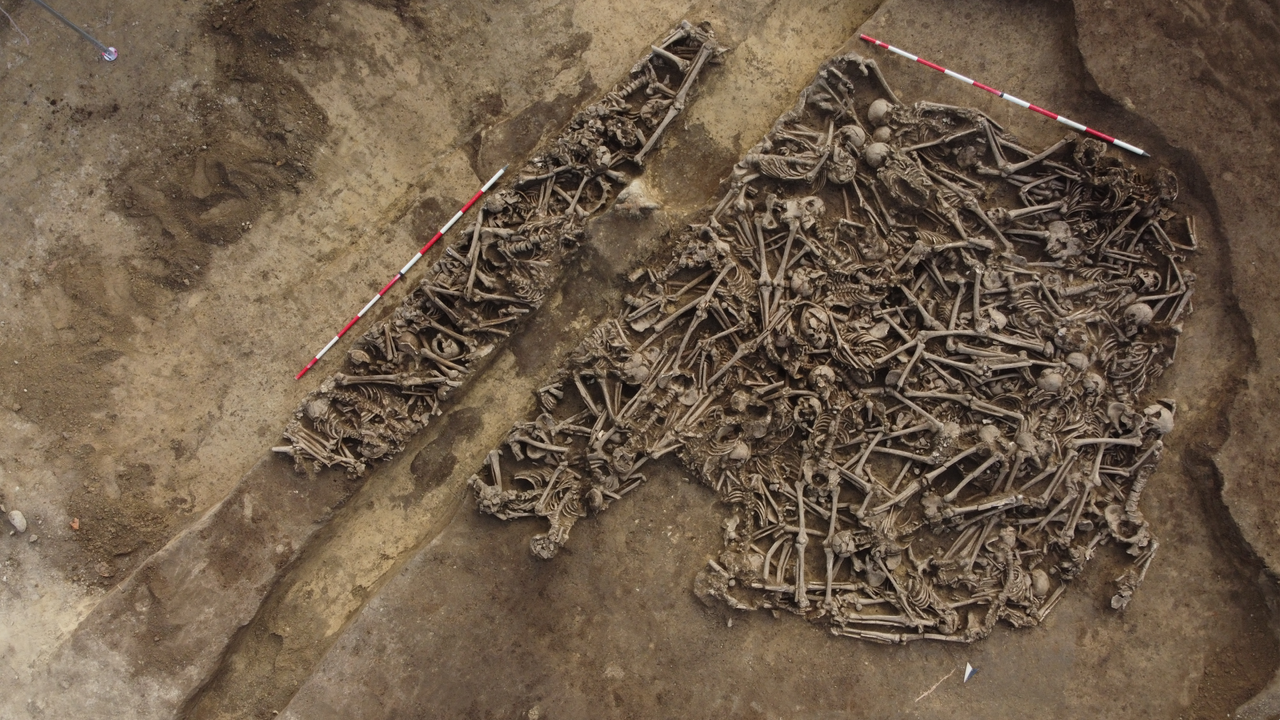
A mass grave discovered in Hasenleitengasse, a neighborhood outside of Vienna, Austria, may hold the remains of casualties from an ancient Roman battle. The grave, dating back to the first to second centuries A.D., contains the skeletons of at least 129 young men, estimated to be aged 18 to 35, from various regions of the Roman Empire.
The burial site, which is extremely disorganized, lacks typical grave goods but reveals evidence of violent trauma, particularly around the groin area. The analysis of the skeletons, presented at the 25th European Paleopathology Association meeting, indicates that these individuals were likely Roman soldiers who died in a mass violence event, possibly a battle or military campaign.
However, no concrete evidence of a battle in the area has been found. The most plausible explanation for the pelvic injuries is that the attackers used a throwing lance, targeting a gap in the enemy's armor as they rode horseback. The discovery of a lance head still inside a pelvis suggests the severity of the injuries sustained.
The DNA analysis of 25 of the skeletons revealed diverse ancestry, suggesting that the combatants may have included Romans and other Germanic tribes. Further research is ongoing to determine the identities and origins of the soldiers, as well as the nature of the conflict that led to their deaths.
Written by urgent.news from Live Science's reporting — not their text. Machine-written — may contain errors; check the original before relying on it.