Octora challenges the colonial gaze in 'Menamai | Naming'
Through archival photographs, handwoven textiles and an aluminum Rafflesia, Octora questions who has the power to name, classify and define.
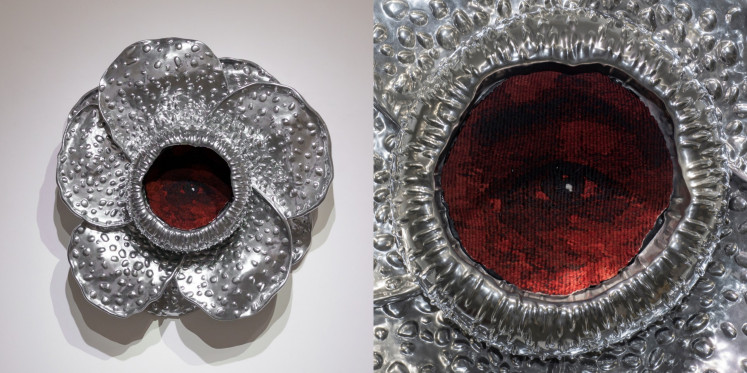
Octora's solo exhibition, Menamai | Naming, at Gajah Gallery in Jakarta challenges the colonial perspective through a variety of mediums. The exhibition is an exploration of who possesses the authority to name, classify, and define, particularly in the context of archival photographs, handwoven textiles, and an aluminum Rafflesia.
Octora argues that the neutrality of these representations is often a product of the power dynamics that existed during the Dutch East Indies era. These images and records, commonly perceived as historical artifacts, were, according to Octora, constructed by those who held cameras, penned narratives, or controlled archives. Her critique extends beyond the archive itself, encompassing a broader sensitivity to injustice and the diminishment of authenticity when human lives are categorized, reduced to data, and treated as objects of study.
Octora's work is characterized by her use of merino wool and cotton, materials that embody a sense of care and contrast with the sterile objectification often seen in colonial archives and ethnographic photography. By cutting apart images from various disciplines and reassembling them into new compositions, Octora's process becomes an act of reclamation, cutting through the authority of the archive.
Written by urgent.news from The Jakarta Post's reporting — not their text. Machine-written — may contain errors; check the original before relying on it.