In Stunning Color, a Celestial “Treasure Chest” Full of Stars
A majestic cometary globule some 7,500 light-years away The post In Stunning Color, a Celestial “Treasure Chest” Full of Stars appeared first on Nautilus .
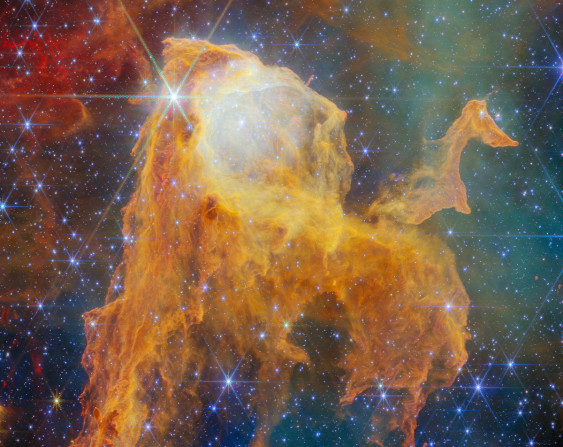
A breathtaking image captured by the James Webb Space Telescope has been named NASA's Picture of the Month. The stunning color photo showcases a cosmic "treasure chest" filled with stars, located about 7,500 light-years away from Earth within the Carina Nebula. Published by NASA, the Canadian Space Agency, and the European Space Agency, the image was dubbed a "cometary globule," a term that derives from its shape resembling a comet with a dense, dark head and a fainter tail. However, these structures have no connection to comets and are simply visually similar.
Within the chest, astronomers estimate that there are around 70 young stars, with the largest being a rare O-type star approximately 19 times more massive than our sun. These super-hot and super-bright stars are of significant interest to researchers studying their formation and evolution. The Carina Nebula, the home of this celestial treasure chest, spans nearly 100 light-years across and is part of the larger Carina constellation, which resides approximately 7,500 light-years away from our planet.
The shape of the treasure chest is partially attributed to the radiation and stellar winds emitted by nearby massive and luminous stars, such as Eta Carinae and the Trumpler 16 system. These two star systems, located 39 light-years away from the Carina Nebula, actively strip away the lighter and less dense dust and gas from the surrounding space. Likely, the chest was once a larger celestial area before being shaped by the powerful forces originating from the stellar treasure inside.
Written by urgent.news from Nautilus's reporting — not their text. Machine-written — may contain errors; check the original before relying on it.