Black Hole Stars Are Apparently Real and Help Explain a Long-Standing Mystery
Astronomers may have discovered a bizarre new type of star with a black hole at its center.
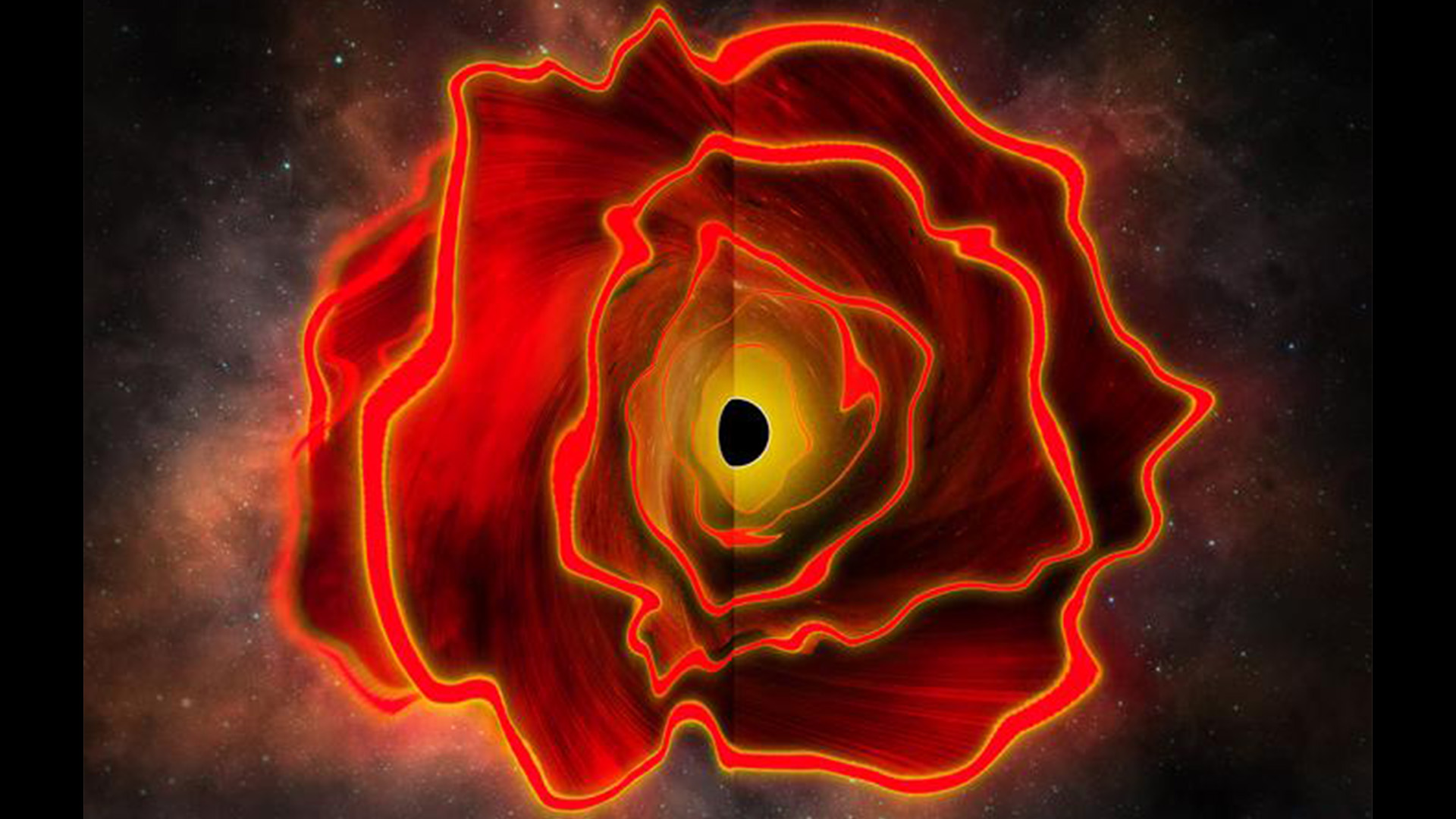
Astronomers may have discovered a real black hole star, an object that exhibits traits of both black holes and stars. Known as MoM-BH*-1, this half-black hole, half-star object was examined by researchers using the James Webb Space Telescope and published their findings in the journal Nature. The hybrid object looks like a star due to its outer shell of very hot and dense gas but has a black hole at its center instead of a traditional molten core.
It is also a colossal size, larger than our entire solar system, and releases over 100 billion times more energy than any known star.
The energy output of MoM-BH*-1 aligns with measurements made from black holes, leading researchers to believe that it might be a new type of celestial body. The object was first observed by the researchers while searching for the oldest galaxies in the universe and learning more about their formation. The researchers were not originally seeking a black hole star; instead, they were investigating these enigmatic objects known as little red dots.
These little red dots are mysterious objects seen in early universe scans, becoming less common as the universe evolved. Scientists have debated their true nature, with one theory suggesting that every little red dot could be a black hole star. The MIT-led research team, led by Dr. Naidu, found that MoM-BH*-1 exhibited similar characteristics to the other little red dots, with the only difference being its brightness.
The red light observed from the object did not come from dust, ruling out nuclear fusion as a source, as seen in typical stars.
In an attempt to explain the unique red light, the research team ran simulations, discovering that it could be produced using only hydrogen, presented as an extremely dense screen of hydrogen. This dense hydrogen layer creates a surface resembling a massive star rather than a thin interstellar nebula. With MoM-BH*-1 displaying many characteristics of other little red dots, researchers may be on the verge of solving the mystery surrounding these enigmatic celestial objects.
Written by urgent.news from CNET's reporting — not their text. Machine-written — may contain errors; check the original before relying on it.