Astronomers Peered at the Early Universe and May Have Discovered a New Kind of Celestial Object: Black Hole Stars
Since the James Webb Space Telescope started collecting data in 2022, it has found puzzling objects dubbed little red dots. A new study suggests they might be giant black holes with some characteristics of stars
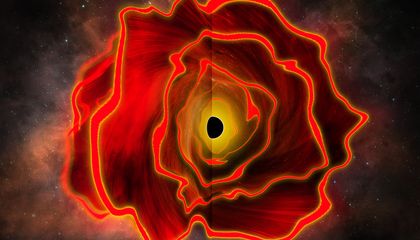
In 2022, NASA's James Webb Space Telescope began observing the early universe and discovered intriguing objects known as little red dots. Astronomers have been trying to determine what these mysterious ruby specks might be. A recent study, published in the journal Nature on August 12, proposes that a particular little red dot called MoM-BH*-1 could be a previously unknown celestial object: a black hole star.
MoM-BH*-1, which existed approximately 660 million years after the Big Bang, appears to be a massive black hole enveloped in a cloud of hot gas. This glowing gas mimics the appearance of a star. The researchers, led by astronomer Rohan Naidu from the University of Hawaii, were astonished by the uniqueness of this object, stating that it is "one in a billion!"
Located 660 million years after the Big Bang, MoM-BH*-1's light took billions of years to reach Earth. The object was identified as part of a survey named Mirage or Miracle (MoM), which aimed to discover galaxies that formed during the early cosmos. MoM-BH*-1 stood out due to its extreme brightness and red color, which typically indicates the presence of dust. However, the light pattern data suggested little dust around the object.
The object's brightness was especially pronounced at a specific wavelength where light typically disappeared, known as a Balmer break. This feature often points to dense gas absorbing starlight in a dust-free environment. However, the Balmer break observed in MoM-BH*-1 was significantly stronger than any seen in a star. Additionally, the object's brightness was too intense to be generated by nuclear fusion, which powers stars.
The team conducted computer simulations to determine the type of object responsible for these peculiar characteristics. Their analysis suggests that MoM-BH*-1 is a black hole with a mass 100,000 times that of the Sun. It is shrouded in a thick cocoon of hydrogen gas, about as large as our solar system.
According to astronomers Dominik Schleicher and Rodrigo Herrera-Camus, who did not contribute to the study, the red color of the system can be attributed to the gas's effects, with little contribution from dust. This discovery provides crucial insights into the nature of little red dots. As of 2025, the James Webb Space Telescope has observed 341 of these crimson anomalies, which are likely black hole stars embedded in early galaxies.
However, MoM-BH*-1 is especially exceptional because the black hole star dominates its surrounding host galaxy, allowing us to see pure black hole star light.
Written by urgent.news from Smithsonian's reporting — not their text. Machine-written — may contain errors; check the original before relying on it.