Art and Culture with Devdutt | Why India’s contribution to mathematics of zero is remarkable
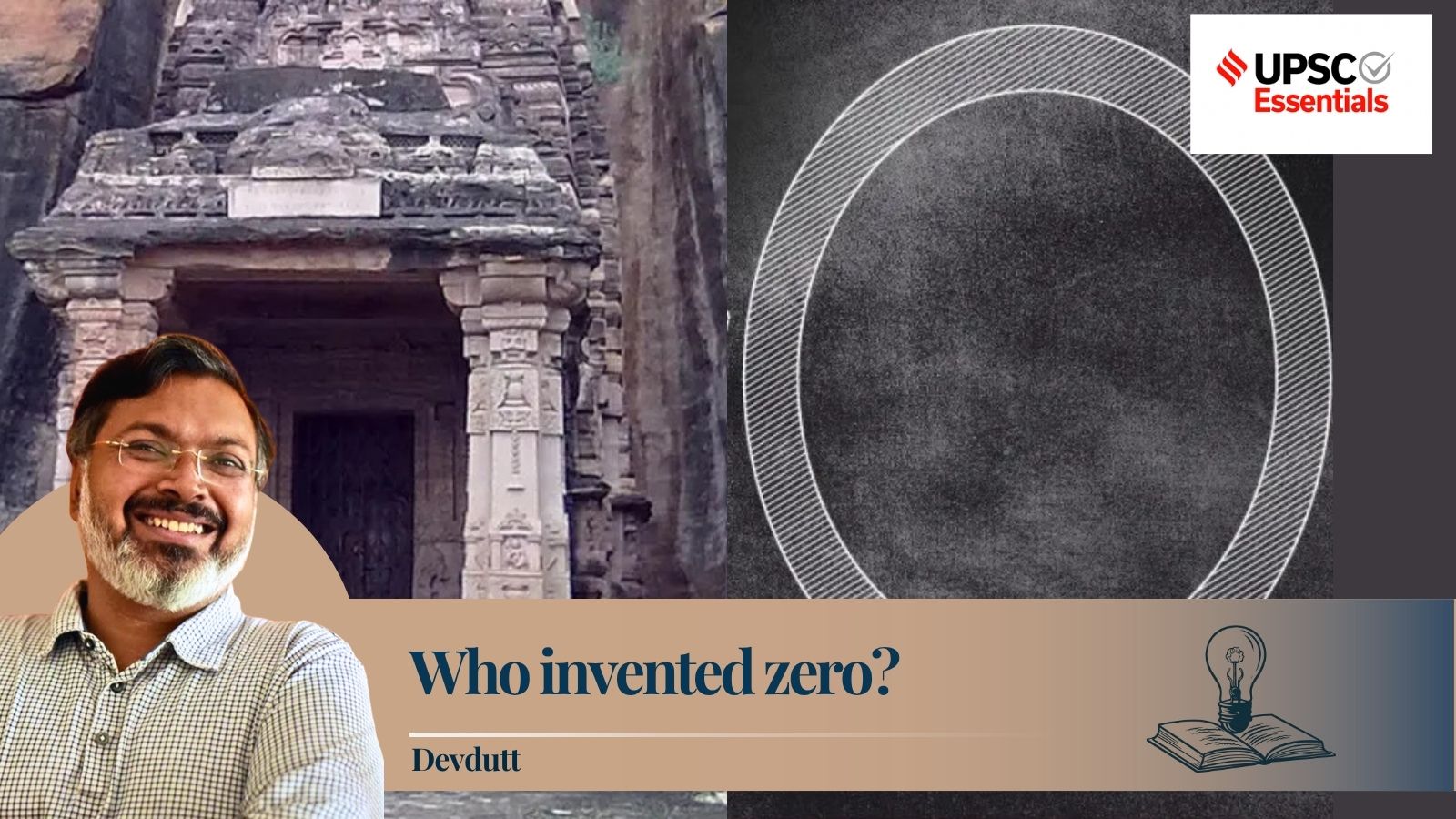
India is often credited with inventing the concept of zero, and this belief is widely taught in schools and public discussions. However, the history of zero is far more complex than a simple claim that one civilization invented it all. To understand the true story of zero, we must separate three distinct ideas: decimal counting, place-value notation, and zero itself. These ideas developed independently at different times and in different locations, showcasing the interconnected nature of mathematical progress.
Decimal counting, the practice of counting in groups of ten, is a system that likely emerged due to humans having ten fingers. Ancient Indian texts like the Rig Veda and Yajur Veda demonstrate that the Indians had a well-developed decimal counting system with names for very large numbers. Yet, this is not unique to India; Greek inscriptions from around 550 BCE and Chinese records from approximately 1500 BCE also employed decimal counting.
Such independent developments across various civilizations highlight the practicality of this counting method, which cannot be attributed to a single country.
The second component of the story is place-value notation, where the position of a digit in a number determines its value. For instance, the digit 1 can represent one, ten, or one hundred depending on its placement. Although early Indian numerals known as Brahmi numerals lacked place value, they had separate symbols for numbers like ten, twenty, and one hundred, akin to Roman numerals.
However, written place-value notation did appear in India around the third century CE. This innovation, where a limited set of symbols generates infinite numbers, mirrors the ancient Sanskrit grammarian Panini's concept of using limited syllables to create an unlimited number of words. The idea of working with infinity (ananta) in Indian mathematics was remarkable, as it was both feared and admired by the Greeks and Chinese.
Zero as a placeholder within a place-value system is the third crucial element of mathematical progress. Without a symbol to denote an empty position, numbers like 204 and 24 would appear identical. While the oldest inscriptions clearly showing a zero symbol are found in Cambodia (dated 683 CE) and Indonesia (around the same time), India also boasts significant contributions.
The earliest undisputed zero inscription is located in the Chaturbhuj Temple in Gwalior, dated to 876 CE, while the Bakhshali manuscript uses a dot for zero, generally dated to around the seventh century CE. These discoveries have led historians to suggest that the written zero symbol might have evolved in Southeast Asia, where Indian culture and Chinese mathematics intersected through trade and cultural exchange.
Regardless of the theory's accuracy, this perspective emphasizes the collaborative nature of knowledge creation, rather than the notion that one civilization alone made a groundbreaking discovery.
India's most remarkable contribution to the mathematics of zero was the treatment of zero as a number with its own mathematical properties. Indian mathematicians developed rules for using zero in calculations such as addition, subtraction, and multiplication, an advancement that significantly transformed the field. This pivotal development eventually spread to the Islamic world, where Arab scholars studied and expanded these ideas.
From there, the knowledge made its way to Europe, ultimately becoming an integral part of the modern number system used globally.
In conclusion, the history of zero is a testament to the collective efforts of several civilizations building knowledge over many centuries. India played a vital role by developing the mathematics of zero and aiding in the creation of the number system that revolutionized the world. This achievement is undeniably remarkable, but it should not be exaggerated to appreciate its true significance.
Written by urgent.news from The Indian Express's reporting — not their text. Machine-written — may contain errors; check the original before relying on it.