Another First for the JWST: It Detects Three Supermassive Black Holes in the Same Galaxy
Astronomers working with the JWST have found a galaxy only 1.3 billion years after the Big Bang that contains three black holes. Two are close to the galaxy's center and will merge soon. The third is more distant, and is expected to merge much later. The discovery shows that black hole mergers were an important contributor to the masses of the SMBH we find in galaxies today.
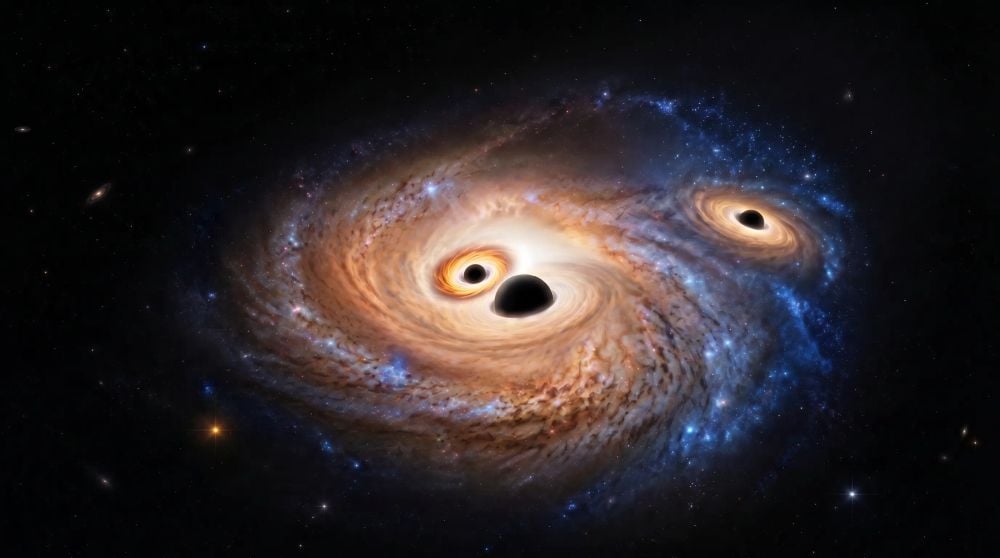
The James Webb Space Telescope (JWST) has made a groundbreaking discovery by detecting three supermassive black holes (SMBHs) within a single galaxy. This marks the first time such a phenomenon has been observed. The study, titled "BlackTHUNDER: Evidence of three massive black holes in a z ∼ 5 galaxy," is presented in the journal Astronomy and Astrophysics.
Lead author Hannah Übler from the Max Planck Institute for extraterrestrial Physics, along with co-author Giovanni Mazzolari, utilized the JWST's NIRSpec Integrated Field Unit to identify and characterize the SMBHs, which possess masses of 80 million, 0.6 million, and 2 million solar masses. The galaxy hosting these black holes, named J0148-4214, lies 12.5 billion light-years away, appearing as it did approximately 1.2 billion years after the Big Bang.
The detection of these SMBHs, along with their associated accretion processes, provides compelling evidence that mergers played a crucial role in the growth and evolution of SMBHs throughout the universe.
Written by urgent.news from Universe Today's reporting — not their text. Machine-written — may contain errors; check the original before relying on it.
This story
This is one outlet's version. Read the fullest account.