Urgent.News

What's breaking now, across thousands of outlets.

Business

Analysis: Whoosh's mounting financial burden is now govt’s problem

The government's decision to take over the debt restructuring of the Whoosh Jakarta-Bandung high-speed railway marks the end of one of Indonesia's largest business-to-business (B2B) infrastructure experiments. A decade after promising the project would not rely on the state budget, the government has been forced to step in. The rescue raises a broader question: If the existing line has yet to…
Analysis: Whoosh's mounting financial burden is now govt’s problem

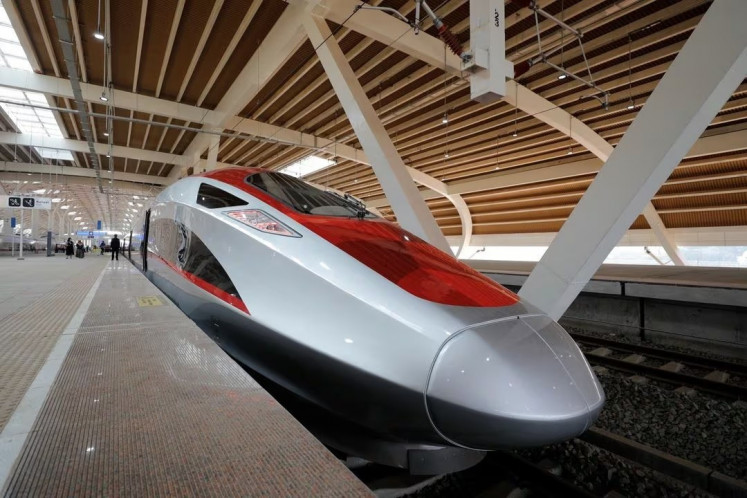
The Indonesian government's decision to assume the debt restructuring of the Whoosh high-speed railway highlights a mounting financial burden for the state. Although originally projected to be a self-sustaining business-to-business (B2B) infrastructure venture, the Whoosh line has repeatedly struggled financially since its inception a decade ago.

With the project's estimated cost ballooning from US$5.5 billion to $7.27 billion, and total debt reaching nearly Rp 79 trillion, the government has been forced to step in to prevent further financial instability.

Written by urgent.news from The Jakarta Post's reporting — not their text. Machine-written — may contain errors; check the original before relying on it.

Read the original at thejakartapost.com →

More in Business

The number of applications for housing demolition permission, or "tocheo" in Korean, for Seoul apartment buildings has been decreasing for three consecutive months. This trend is also reflected in the slowing down of rising apartment prices in Seoul. According to the Seoul Metropolitan Government, the number of tocheo applications received from January to March this year was 6,337. This represents a 32.7% decrease compared to the 9,421 applications received during the same period last year. Compared to the monthly figures, January saw 2,568 applications, February 2,091, and March 1,678. The number of applications has been decreasing for three consecutive months since January. The decrease in tocheo applications is also reflected in the slowing down of rising apartment prices in Seoul. According to the Korea Real Estate Board, the average price of apartments in Seoul rose 0.38% in March. This is a decrease from the 0.45% increase in February and the 0.83% increase in January. Experts say that the decrease in tocheo applications and the slowing down of rising apartment prices are due to the government's measures to control the real estate market. The government has been implementing various measures to cool down the real estate market, including increasing the down payment ratio and tightening lending regulations. As a result, experts predict that the real estate market will continue to slow down in the coming months. However, some experts also note that the decrease in tocheo applications may not necessarily mean that the real estate market is slowing down. They argue that the decrease in applications may be due to the fact that many developers are choosing to delay their projects until the government's policies become clearer. In any case, the trend of decreasing tocheo applications and slowing down of rising apartment prices is expected to continue in the coming months. The government will continue to monitor the real estate market and implement measures to ensure that it remains stable.

More from Friday 14 August →