Wing and a prayer: how probiotics might save bat species from a killer fungus
Bat experts were shocked at how fast white-nose syndrome had spread to Canada’s northernmost colonies from the US. Now, the race is on to find a cure before species disappear Crawling through a narrow passage in a cave beneath a boreal forest near Fort Smith in Canada’s Northwest Territories in May, two biologists spotted a lifeless bat on a limestone ledge, its body covered in a spindly white…
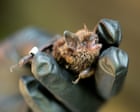
Bat experts were astounded at the rapid spread of white-nose syndrome from the United States to Canada's northernmost colonies. In a cave near Fort Smith, Canada's Northwest Territories, biologists discovered a dead bat covered in white fungus and another with the fungus on its forearms. Jesika Reimer, an ecologist specializing in bat populations in northern Canada and Alaska, was certain that the deadly disease, caused by the fungus Pseudogymnoascus destructans (Pd), had reached the region.
White-nose syndrome had already killed over 6.7 million bats across North America since its appearance in 2007 in New York state.
Reimer and her colleague Joanna Wilson, a biologist for the Northwest Territories government, had been monitoring the fungus's spread across the continent for 20 years. They were shocked to find the fungus in Fort Smith, a town about 450 miles south of the Arctic Circle. The biologists had hoped to conduct a baseline survey of healthy, stable bat populations before the fungus arrived, but now faced an urgent threat to bat populations in Canada and Alaska.
The caves near Fort Smith were first discovered in 2010 and are the largest hibernaculum in western Canada, sheltering an estimated 3,000 bats, including little brown bats, big brown bats, and northern long-eared bats. These caves have been crucial to understanding the behavior of northern bats. However, smaller species of bats, such as little brown and northern long-eared myotis bats, are particularly vulnerable to white-nose syndrome. Both are listed as species of special concern in the Northwest Territories.
White-nose syndrome attacks the face, wings, and arms of bats while they are hibernating, causing them to stir from rest and groom themselves, leading to rapid fat and energy depletion. This results in dehydration or starvation, ultimately causing the bats' death. In May, Reimer and Wilson captured bats outside the cave entrance using lightweight mist nets, documenting infected bats with white fungus riddling their wing membranes and showing signs of necrosis.
One infected bat was found dehydrated and unable to fly, with brittle wings. Laboratory tests confirmed the presence of white-nose syndrome, though mass die-offs were not observed, possibly due to the sub-arctic latitude of the caves or the bats' adaptive abilities.
Written by urgent.news from Guardian Science's reporting — not their text. Machine-written — may contain errors; check the original before relying on it.