What is Agentic SRE? The Next Evolution of Reliability Engineering
Discover how agentic SRE uses AI reasoning, continuous learning, and predictive quality to prevent software failures before they reach customers.
Modern software systems consist of numerous interdependent services that continuously evolve as new code is released. This rapid pace of change places immense pressure on Site Reliability Engineering (SRE) teams to maintain high reliability standards without sacrificing the speed of delivery. Traditional SRE methods are struggling to keep up, leading to alert fatigue and engineers spending more time firefighting than innovating.
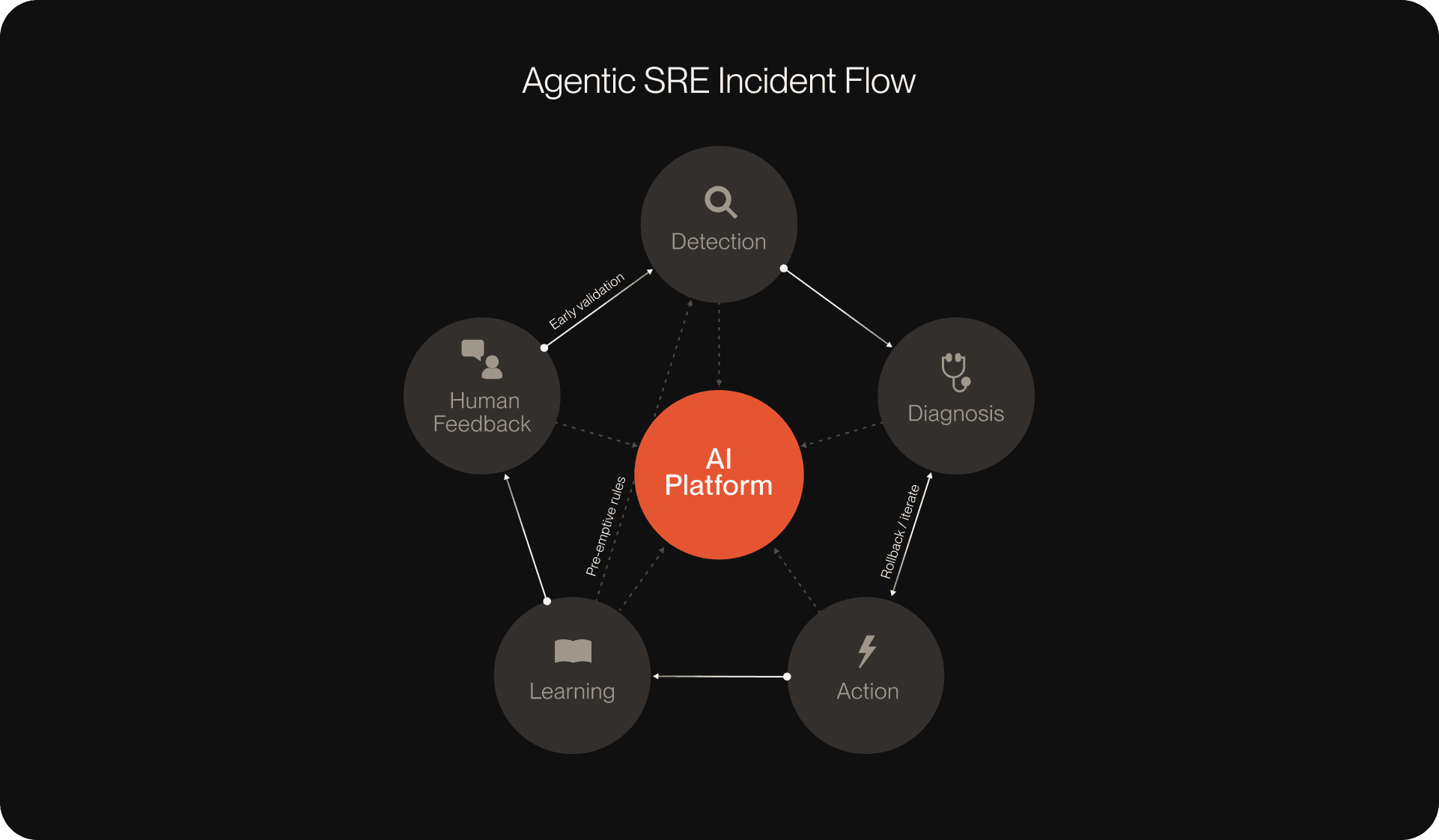
Agentic SRE marks the next evolution in reliability engineering. It moves away from reactive, emergency-driven approaches and instead focuses on proactive prevention. By incorporating artificial intelligence (AI) and continuous learning directly into the software development lifecycle, agentic SRE aims to streamline processes, reduce noise, and address root causes of issues before they impact customers.
Current SRE practices, while important, reach their capacity limits in modern environments. The sheer volume of signals, dependencies, and customer demands is overwhelming. Foundational SRE practices such as runbooks, monitoring, and incident response frameworks are crucial, but they become strained at enterprise scale. Knowledge silos, slow triage, and symptom-chasing are major bottlenecks.
When critical issues arise, they often take hours to resolve due to the scattered nature of critical contextual information. Additionally, patching symptoms rather than addressing root causes leads to recurring problems, consuming valuable engineering hours that could be spent on innovation.
At its core, the issue lies in the complexity and scale of modern systems. Traditional approaches of adding more SREs or monitoring tools can provide short-term relief but fail to tackle the fundamental problems. As systems span hundreds of distributed services and generate thousands of code changes weekly, human-driven processes cannot analyze every regression or keep up with the pace of change.
The 2025 SRE Report reveals that SRE teams now spend an average of 30% of their time on toil, up from 25% just a year prior, with a median outage costing $14,056 per minute and up to $23,750 per minute for large enterprises.
Reliability must evolve from a reactive function to an upstream, systemic quality assurance process. By embedding quality checks and continuous learning into the development lifecycle, teams can prevent defects before they reach production. This systemic quality approach reduces escalations, lowers defect escape rates, and frees up engineering capacity for innovation.
For instance, Cayuse, a company adopting predictive software quality platforms, saw a 90% reduction in customer-facing issues and an 80% decrease in resolution times, allowing teams to focus on building rather than fixing.
Agentic SRE leverages AI to enhance the reactive response to reliability issues while simultaneously building a proactive framework for systemic prevention. It breaks down fragmented operational context, automates cross-system analysis to expedite root cause discovery, and systematically reduces the frequency of recurring incidents.
By combining cross-system AI reasoning, it correlates signals across code and tickets to provide a holistic view of system health. This approach addresses the limitations of traditional SRE methods, enabling teams to achieve higher reliability with reduced costs and increased innovation.
Written by urgent.news from HackerNoon's reporting — not their text. Machine-written — may contain errors; check the original before relying on it.