Watch: Australian Dolphin Filmed Catching Fish with Shells
Yet another example of dolphins’ exceptional cognitive abilities The post Watch: Australian Dolphin Filmed Catching Fish with Shells appeared first on Nautilus .
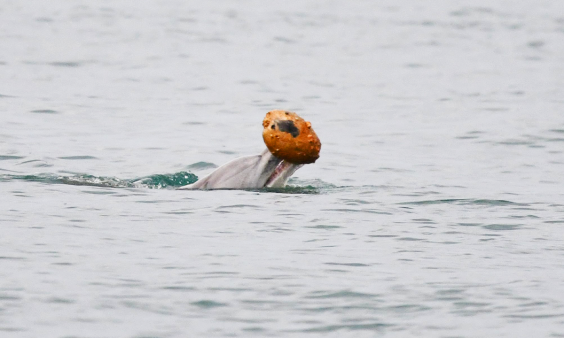
In a recent study published in Marine Mammal Science, Australian dolphins were observed using shells to catch fish, demonstrating their impressive cognitive skills. This behavior, known as "shelling," involves dolphins lifting large conch shells from the water, shaking them to remove water and trap a fish inside, and then bringing the shell to the surface to consume the trapped fish.
The phenomenon was first noted 15 years ago in Western Australia, where Indo-Pacific bottlenose dolphins (Tursiops sp.) were seen engaging in this behavior. Since then, multiple instances of shelling have been observed in dolphins in the region. Now, a new study reveals that dolphins in Eastern Australia are also practicing shelling.
The research, conducted by a team of marine mammal biologists, included footage of two instances of shelling captured by researchers, as well as reports from a dolphin tour company. Lead study author Alexis Levengood, a marine mammal biologist at the University of the Sunshine Coast, recalled the moment she first witnessed the behavior while on a research boat. "I started screaming because I know what shelling looks like," she said, expressing her excitement upon recognizing the behavior.
Handling the conch shell requires specialized skills that dolphins must somehow learn and teach to other members of their pod. Previous research suggested that shelling may be learned through horizontal learning between dolphin peers rather than through parent-offspring transmission. However, the new study conducted in the Great Sandy Marine Park in Queensland found evidence of maternal social transmission between mother and offspring through observational learning.
In the study, a mother dolphin was observed surfacing multiple times with a large bailer shell on her nose. After dropping the shell, her calf surfaced with the shell on its nose, holding it like the mother and then slapping it on the water surface. It is unclear whether either dolphin successfully caught any fish trapped inside the shell, but the parallel behaviors observed suggest that the mother dolphin's actions were passed down to her calf through social learning.
The researchers concluded that these observations are "suggestive of (maternal) social transmission between mother and offspring through observational learning." This discovery not only showcases the remarkable cognitive abilities of dolphins but also sheds light on their language acquisition and could potentially provide insights into our own language development.
Interestingly, the behavior of shelling may also have implications for understanding cultural behaviors among animals. Unlike African cheetahs, dolphins display a flexible carnivorous nature, and the accumulation of skills through social learning could be a rare, potentially cultural behavior observed in various groups of wild chimpanzees in West Africa.
Written by urgent.news from Nautilus's reporting — not their text. Machine-written — may contain errors; check the original before relying on it.