The Guardian view on solar eclipses: moments of wonder that bring us together | Editorial
Wednesday’s eerie spectacle united crowds beneath the sky, continuing a human fascination that stretches from ancient myth to modern physics “I’d describe it as a magical eeriness.” Lisa Redfern’s description to the Guardian conveys the combination of beauty and wrongness that accompanied Wednesday’s partial solar eclipse in Britain. Crowds across the country assembled as the sun’s power seemed…
On Wednesday, a captivating celestial event unfolded, uniting crowds across Britain beneath the sky. This experience echoed a long-standing human fascination, stretching from ancient myths to modern physics. Observer Lisa Redfern aptly described the partial solar eclipse as "magical and eerie," highlighting the beauty and strangeness that accompanied the event.
Across the nation, people gathered to witness the sun's power seemingly wane, the sky transforming abruptly as twilight descended. The temperature dropped, and familiar landscapes appeared unnatural under the altered conditions. Redfern emphasized that Britons "may not see another one like this for 55 years," urging the country to cherish these extraordinary moments.
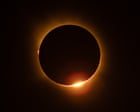
To truly experience the eclipse's full wonder, one must be within the path of totality, where the sun is completely obscured. This week, the path of totality crossed over Greenland, Iceland, and Spain, where the sun was entirely hidden by the moon. In Britain, however, the moon only partially covered the sun, leaving behind a thin yellow crescent.
In the realm of totality, a striking transformation occurs. For a brief few minutes, a black disc appears where the sun should be, surrounded by a fiery corona against a purplish backdrop. It is another 64 years before Britain will witness another total solar eclipse.
Written by urgent.news from Guardian Science's reporting — not their text. Machine-written — may contain errors; check the original before relying on it.