Totality! See incredible photos of the Aug. 12 total solar eclipse from across Europe
The UK and Europe have witnessed their most spectacular solar eclipse in nearly three decades, with millions of people viewing the once-in-a-generation celestial event. The partial eclipse peaked shortly after 7:00 PM local time, with most observers seeing more than 90% of the Sun covered by the Moon. However, far-north locations such as Greenland, Iceland, and Spain experienced the awe-inspiring total eclipse.
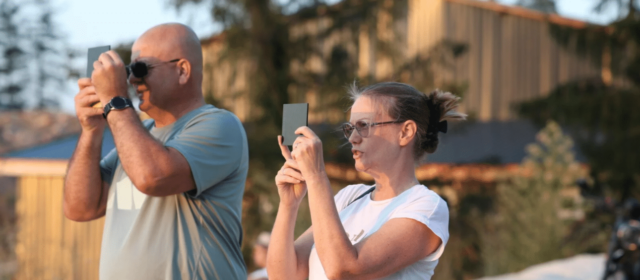
Large crowds gathered at viewing sites across the UK and Europe, reacting with gasps and cheers as they watched the impressive spectacle. The total eclipse began at the northern tip of Siberia in Russia, near the Arctic Ocean, and spread southwards to reach Iceland before entering the UK.
The partial eclipse commenced around 6:00 PM BST in northern Scotland and just before 6:20 PM on the southern coast of England. It started out imperceptible, but as the Moon nibbled away at the Sun, crowds noticed and marveled at the sight. Much of central and southern England, along with Wales, enjoyed clear skies, offering an unparalleled view of the Moon's slow movement across the Sun throughout the hour-long event.
Northern England, Scotland, and Northern Ireland experienced cloudier conditions, yet crowds still gathered at popular landmarks to view the event. Although solar eclipse glasses were in short supply, people still managed to safely view the partial eclipse using improvised methods like colanders, cereal boxes, and pieces of paper.
A solar eclipse occurs when the Moon passes between the Sun and Earth, casting a shadow on our planet. From the UK, the Sun, Moon, and Earth were not perfectly aligned, resulting in a partial eclipse, with the Moon covering about 90% of the Sun for most of the country – the UK's most dramatic eclipse since 1999. In Cornwall, the coverage reached up to 95%.
Some Spanish locations were treated to a total eclipse, with the Sun, Moon, and Earth perfectly aligned around 7:30 PM BST (8:30 PM local time). The combination of the red glow of the Sun hidden behind the Moon and the pink loops of gas called prominences, following the Sun's turbulent magnetic field, left spectators cheering and sharing their excitement.
The total solar eclipse is a rare occurrence, taking place somewhere on Earth roughly every 18 months, but only once every 400 years for any given location. Eclipse chasers can look forward to a "golden age" of total solar eclipses between 2026 and 2028, with three events happening in that span. However, none of these events will be visible in the UK, with the best the country will see being a partial eclipse in 2027, with about 45% coverage in certain regions.
The UK's next total solar eclipse will occur in 2090, offering a chance to witness up to 99% of the Sun being covered.
Written by urgent.news from Adom Online's reporting — not their text. Machine-written — may contain errors; check the original before relying on it.
This story
This is one outlet's version. Read the fullest account.
- Once-in-a-generation solar eclipse wows millions in UK and Europe adomonline.com
- Solar eclipse 2026 across Europe: in pictures theguardian.com
- Solar eclipse 2026 in pictures: The best shots from around Europe euronews.com
- Total solar eclipse dipped parts of Europe into complete darkness. Here's what they saw. cbsnews.com
- See Magnificent Photos of the Total Solar Eclipse Over Europe That Showcase the Sun's Beauty and the Wonder of Skywatching smithsonianmag.com
- Once-in-a-generation solar eclipse wows millions in UK and Europe myjoyonline.com
- Photos: Total solar eclipse darkens skies across Europe timesofindia.indiatimes.com
- Totality! See incredible photos of the Aug. 12 total solar eclipse from across Europe r.smartbrief.com