Major Russian aerospace manufacturer that produces Proton and Angara rockets reports equipment wear of up to 90%
The Khrunichev State Research and Production Space Center, a leading enterprise in Russia’s rocket and space industry, told Russia’s Industry and Trade Ministry that physical wear of equipment in some workshops has reached 90%, while the average age of its equipment is 29 years. The information appears in correspondence between the company and the ministry that was reviewed by The Insider . The…
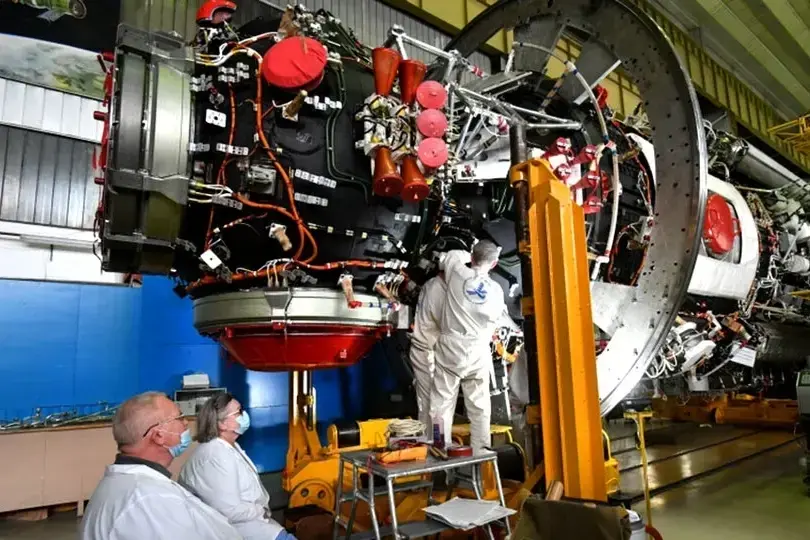
The Khrunichev State Research and Production Space Center, a major Russian aerospace manufacturer, has reported that the equipment in some of its workshops is experiencing wear levels of up to 90%. The center, which is responsible for producing the Angara and Proton launch vehicles, is currently facing significant production bottlenecks and critical vulnerabilities due to its aging equipment.
The average age of the equipment in the workshop responsible for heat treatment, hot stamping, metal cutting, and sandblasting is just 20 years old, with physical wear also reaching 90%. This workshop is also lacking a waterjet cutting unit and an electric furnace.
In another workshop, the average age of equipment is 29 years with an average wear of 80%. The production bottleneck in this area is a CNC vertical milling machining center, which requires four units.
The center has also highlighted a critical need for a spin-forming machine in a workshop that manufactures various parts such as skins, end caps, hemispheres, pipe connections, bottom sectors, flanges, fairings, cups, and bellows. Additionally, welding equipment and a test pumping station are missing from the workshop that manufactures, assembles, welds, and tests low- and high-pressure hoses.
The Khrunichev Center is asking for the renewal of its industrial equipment, including an industrial sharpening machine and a German Wenzel XO 108 coordinate measuring machine. The center is confident it can obtain these requested items from China, despite claims from the Republic of China (Taiwan) that such shipments are banned. This indicates that the Chinese government's export restrictions on dual-use goods to Russia's military-industrial complex may not be as effective as they claim.
Written by urgent.news from The Insider's reporting — not their text. Machine-written — may contain errors; check the original before relying on it.