How Fluid Mixing due to Kelvin-Helmholtz Instabilities Really Works
Physical oceanographers might have a misconception about the anatomy of mixing at realistic Reynolds numbers in this important type of shear instability.
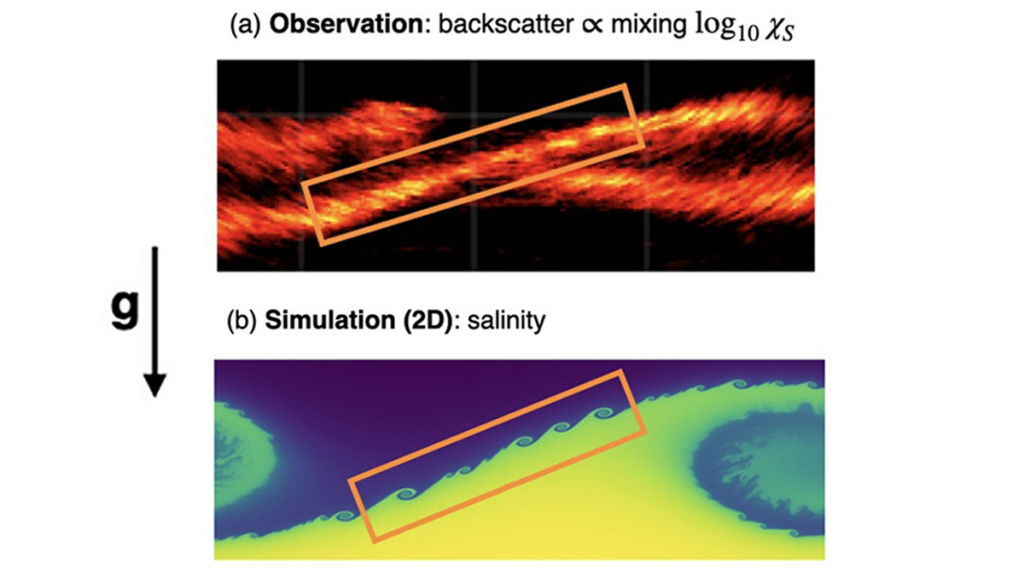
One of the most significant hydrodynamic instabilities that induces turbulence and mixing in marine systems is the specific type of shear instability known as the Kelvin-Helmholtz (KH) instability. Historically, when we envision KH instabilities, we usually picture the rapid formation of the distinctive overturning billows that become gravitationally unstable and eventually collapse into turbulence.
However, a recent study led by Lefauve et al. [2026] challenges this conventional understanding. Using groundbreaking acoustic field data from a shallow estuarine system, laboratory experiments, and high-resolution idealized simulations, the researchers reveal that at high Reynolds number in real geophysical flows, the primary pathway to turbulence may differ from what we typically assume.
The core finding of this study is that the dominant mixing mechanism isn't the overturning and collapse of the primary KH billow cores, but rather the intense mixing occurring in thin "braids" that link adjacent billows. These braids facilitate strong, localized shear, resulting in secondary instabilities and turbulence. Although this discovery isn't entirely novel, it might not be widely recognized within the oceanographic research community. However, the study stands out due to its innovative methods and findings.
For the first time, the authors utilized multibeam echosounding field data to present an undistorted view of the KH instability geometry, allowing for accurate estimation of the energetic braids' slopes. Based on this data, the researchers introduce a predictive scaling framework that enables the determination of dissipation and scalar mixing using only the local braid slope, shear, and layer thickness.
Additionally, the study identifies a complete lifecycle of braids, which begin as thin structures sharpening to centimeter scales, develop secondary KH-like structures on the braids themselves, transition to approximately 0.1 m turbulence, and finally decay into disorganized turbulent filaments.
The authors propose that oceanic stratified mixing hotspots might be primarily controlled by continuously forced, filamentary braid turbulence generated by secondary instabilities. This finding challenges the current focus in observations and parameterizations, which are mainly centered on primary KH overturning.
Written by urgent.news from Eos's reporting — not their text. Machine-written — may contain errors; check the original before relying on it.