Half a million visitors flock to Spain’s path of total solar eclipse
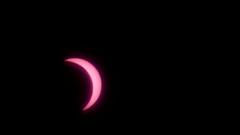
Spain witnessed its first total solar eclipse in more than a century on Wednesday 12 August, drawing millions of people to viewing sites across the north of the country as the Moon passed directly in front of the Sun.
On Wednesday, Spain experienced its first total solar eclipse in over a century, captivating crowds across the nation and neighboring Europe with a stunning celestial event. The moon's shadow briefly plunged Spain into darkness, revealing the sun's outer corona for a brief 90 minutes after its initial appearance in northern Russia.
Isabel Troyano, a 56-year-old woman from Tarragona, described the experience as "incredible" and said she was "shaking with goosebumps." Alejandro Cuesta, a 30-year-old nanoscience researcher, expressed his awe, saying the event was "magnificent" and the most beautiful thing he had ever witnessed.
The eclipse, a first in mainland Europe since 2006, traveled through Greenland before casting its shadow over Iceland, where Reykjavik had not seen a total solar eclipse since 1433. In Spain, the lunar shadow moved diagonally from the northern coast to the Balearic Islands, attracting tourists and locals who gathered on beaches to view the phenomenon dressed in swimming costumes and equipped with protective glasses.
Supplies of special viewing glasses were in high demand as the partial eclipse was visible across Europe, Canada, the northern United States, and northwest Africa.
Throughout history, eclipses have elicited amazement, fear, and reverence due to their temporary nature and the strange effects they create. The shadow, or "umbra," cast by the alignment of the sun and moon causes temperatures to drop, shadows to appear at unusual angles, and some animals to go to sleep. However, the event is fleeting, lasting only minutes as the lunar shadow races across the Earth at a speed of 3,430 km/h (2,130 mph). The partial eclipse lasted approximately one hour and 45 minutes.
The eclipse, live-streamed by NASA and the European Space Agency, provided scientists with a rare opportunity to study the Sun's atmosphere and its outermost layer, aiding in the understanding of solar winds and the star's magnetic field. Despite concerns about potential rain in the Westfjords region of northwest Iceland, tens of thousands of tourists and locals were treated to a darkened sky as the country went dark.
The experience was described by visitors such as Glenn Rosa, a 44-year-old retail manager from Houston, Texas, who shed "a tear or two" upon witnessing the darkness pass over Keflavik and its lighthouse, and Mylisha Lanegan, a 34-year-old teacher from Washington state, who found it "almost indescribable."
Clear skies in Spain allowed for excellent visibility, despite concerns of high temperatures and the risk of wildfires. The government predicted that nearly 450,000 extra tourists could bring a €347 million (US$400 million) economic boost to the country. Police mobilized to ensure the event's smooth execution, with British astrophysicist and science communicator Graham Jones highlighting the unique opportunity for Spanish observers, as the path of totality spans a narrow 200-kilometer-wide path across the peninsula.
Another total eclipse is expected in southern Spain and northern Africa in 2027, while an annular eclipse – creating a "ring of fire" – is anticipated to visit the Iberian Peninsula in 2028.
Written by urgent.news from South China Morning Post's reporting — not their text. Machine-written — may contain errors; check the original before relying on it.
This story
This is one outlet's version. Read the fullest account.