Ghana’s 24-Hour Economy needs a new bank
Ghana’s ambition to build a productive 24-Hour Economy could face a major financing constraint unless the country changes how it funds agriculture and industry, with private-sector players proposing a Value Chain Industries Bank (VCIB) to provide long-term capital from raw-material production through manufacturing to the final market. The proposed private-sector-led development finance…
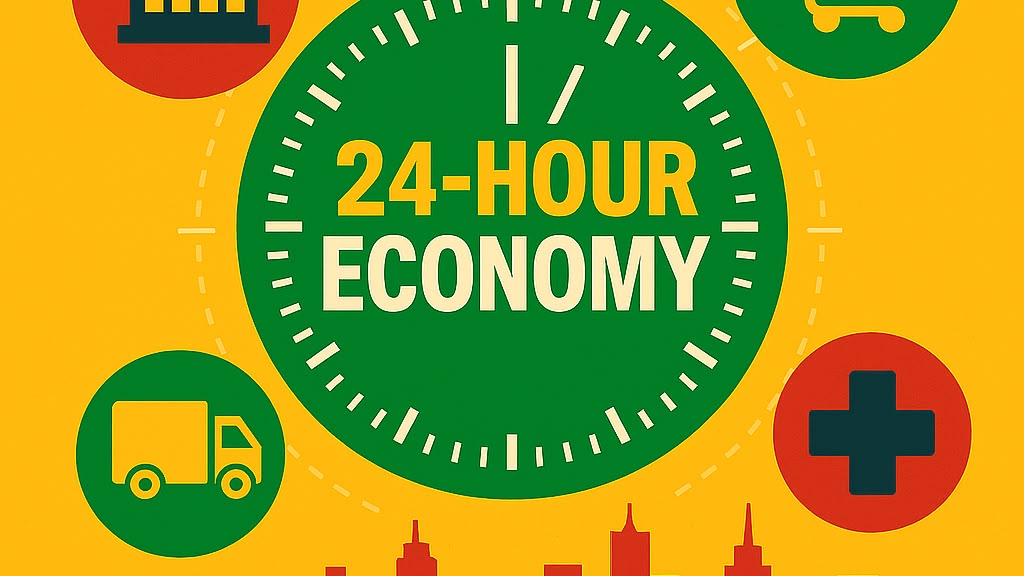
Ghana's aspiration to establish a thriving 24-Hour Economy could encounter significant financing challenges unless the nation reevaluates its approach to funding agriculture and industry. Private-sector entities propose the establishment of a Value Chain Industries Bank (VCIB) to supply long-term capital throughout the entire production process, from raw-material production through manufacturing to the final market.
The proposed development finance institution, driven primarily by the private sector, would target sectors such as agriculture, manufacturing, fast-moving consumer goods (FMCGs), and export value chains. Industry stakeholders contend that there is an ongoing disparity between short-term financing and the extended investment periods required to cultivate competitive industries.
Ghana cannot achieve sustainable expansion of manufacturing, substitution of imports, and augmentation of exports solely by financing factories while neglecting the underfunded farms, suppliers, distributors, and markets that support those factories. President John Dramani Mahama's 24-Hour Economy initiative aims to enhance production, employment, and value addition.
However, operating factories for extended hours necessitates greater raw materials, working capital, logistics, warehousing, and market demand. Consequently, financing needs must follow the entire production chain rather than treating factories as isolated investments. An agro-processing company, for instance, might need to construct a factory while concurrently developing extensive raw material reserves, establishing outgrower networks, creating distribution channels, and penetrating both domestic and export markets.
These investments can take up to a decade to yield returns, yet certain industrial projects have been compelled to operate under financing periods of approximately six years, resulting in repayment pressures before their agricultural and commercial ecosystems achieve sufficient scale. The VCIB would attempt to rectify this financing gap by aligning the duration of financing more closely with the gestation period of the financed industry.
The experience of indigenous agro-processing companies like Ekumfi Fruits & Juices underscores this issue. A substantial processing facility cannot function effectively without sufficient raw materials, and when financing builds factory capacity without subsequently expanding farms and outgrower production, utilization may remain below installed capacity.
Low utilization elevates unit costs, diminishes competitiveness, and strains cash flow and debt servicing. Unlike a wholly state-owned development bank, the VCIB would primarily be private-sector driven, involving manufacturers, agribusinesses, FMCGs, institutional investors, and private capital. The government would participate as a strategic partner or minority investor.
One of the VCIB's proposed innovations is the greater recognition of biological assets in agricultural financing. Commercial cocoa, oil palm, citrus, avocado, and other plantations possess future production potential but may not receive adequate acknowledgment under traditional collateral structures. With appropriate valuation, insurance, legal enforceability, and prudential requirements, the VCIB would assess agricultural investments using a combination of land, biological assets, anticipated yields, confirmed offtake, and projected cash flows rather than relying predominantly on conventional fixed collateral.
The proposed bank would also prioritize demand. Instead of solely evaluating the collateral owned by producers, financing decisions could incorporate the demand for the output. Credible offtake agreements involving FMCGs, processors, distributors, supermarkets, and exporters could be integrated into the assessment of a project's capacity to generate revenue and repay financing.
This approach effectively shifts industrial financing from "finance, produce, and search for a market" to "identify demand, secure offtake, produce, and finance." This could bolster Ghana's import-substitution strategy by identifying products that can be competitively produced within the country and directing financing across the raw-material, processing, manufacturing, and distribution chain necessary to replace imports.
Competitive industries could subsequently be nurtured into AfCFTA and international markets, converting import substitution into export earnings and foreign-exchange generation. Digital payments could further bolster the model, provided that regulatory and data-protection requirements are met and verified transactions are available across farmers, suppliers, manufacturers, distributors, and retailers to enhance lenders' visibility into actual turnover and facilitate increased use of cash-flow-based financing.
The proposal holds particular significance for the 24-Hour Economy. Factories cannot merely introduce additional production shifts without procuring more raw materials. More raw materials necessitate agricultural investment, higher production requires working capital, increased output demands logistics and warehousing, and ultimately, the additional goods require domestic or export markets.
A 24-hour factory thus requires a 24-hour value chain— and that value chain necessitates appropriate financing. The VCIB proposal must still demonstrate its viability as a financially sustainable and properly regulated institution. Proponents are anticipated to engage with government and the Bank of Ghana regarding feasibility, licensing, capitalization, ownership, governance, and the suitable prudential framework.
If Ghana intends to enhance what it processes, process more of what it grows, substitute imports, and expand exports, financing must extend beyond the factory gate. It must permeate the entire value chain—from raw materials to the final market.
Written by urgent.news from MyJoyOnline Ghana's reporting — not their text. Machine-written — may contain errors; check the original before relying on it.